Value Chain Analysis describes the activities that take place in a business and relates them to an analysis of the competitive strength of the business. Influential work by Michael Porter suggested that the activities of a business could be grouped under two headings:
(1) Primary Activities - those that are directly concerned with creating and delivering a product (e.g. component assembly); and
(2) Support Activities, which whilst they are not directly involved in production, may increase effectiveness or efficiency (e.g. human resource management). It is rare for a business to undertake all primary and support activities.
Value Chain Analysis is one way of identifying which activities are best undertaken by a business and which are best provided by others ("out sourced").
Linking Value Chain Analysis to Competitive Advantage
What activities a business undertakes is directly linked to achieving competitive advantage. For example, a business which wishes to outperform its competitors through differentiating itself through higher quality will have to perform its value chain activities better than the opposition. By contrast, a strategy based on seeking cost leadership will require a reduction in the costs associated with the value chain activities, or a reduction in the total amount of resources used.
Primary Activities
Primary value chain activities include:
Primary Activity
Inbound logistics: All those activities concerned with receiving and storing externally sourced materials.
Operations: The manufacture of products and services - the way in which resource inputs (e.g. materials) are converted to outputs (e.g. products)
Outbound logistics: All those activities associated with getting finished goods and services to buyers
Marketing and sales: Essentially an information activity - informing buyers and consumers about products and services (benefits, use, price etc.)
Service" All those activities associated with maintaining product performance after the product has been sold.
Support Activities
Support activities include:
Secondary Activities
Procurement: This concerns how resources are acquired for a business (e.g. sourcing and negotiating with materials suppliers)
Human Resource Management: Those activities concerned with recruiting, developing, motivating and rewarding the workforce of a business.
Technology Development: Activities concerned with managing information processing and the development and protection of "knowledge" in a business .
Infrastructure: Concerned with a wide range of support systems and functions such as finance, planning, quality control and general senior management .
Steps in Value Chain Analysis
Value chain analysis can be broken down into a three sequential steps:
(1) Break down a market/organisation into its key activities under each of the major headings in the model;
(2) Assess the potential for adding value via cost advantage or differentiation, or identify current activities where a business appears to be at a competitive disadvantage;
(3) Determine strategies built around focusing on activities where competitive advantage can be sustained

Showing posts with label Strategic Management Tools. Show all posts
Showing posts with label Strategic Management Tools. Show all posts
Wednesday, August 10, 2011

Thursday, August 4, 2011
Game Theory as Strategic Management Tool
Game Theory
Game theory is a reasoned attempt to predict behavior. It applies in situations where an individual's success in making choices depends on the choices of others.
Imagine if you can predict or anticipate what your competitors are going to do, you probably be in a competitive position to outdo your rivals by implementing better moves to conquer the market. This is the essence of Game Theory.
Game theory studies competitive and cooperative behavior in strategic environments, where the fortunes of several players are intertwined. It provides methods for identifying optimal strategies and predicting the outcomes of strategic interactions.
The field of game theory began around 1900 when mathematicians began asking whether there are optimal strategies for parlor games such as chess and poker, and, if so, what these strategies might look like. The first comprehensive formulation of the subject came in 1944 with the publication of the book Theory of Games and Economic Behavior by famous mathematician John von Neumann and eminent economist Oskar Morgenstern. As its title indicates, this book also marked the beginning of the application of game theory to economics.
Since then, game theory has been applied to many other fields, including political science, military strategy, law,
computer science, and biology, among other areas.
Game Theory Strategy
The idea of business as a game, in the sense that a move by one player sparks off moves by others, runs through much strategic thinking. It is borrowed from a branch of economics (game theory) in which no economic agent (individual or corporate) is an island, living and acting independently of others.
In sectors where firms compete fiercely for market share and customer loyalty, this stylised progression of moves closely parallels actual behaviour.
Seeing business life as a never-ending series of games, each of which has a winner and a loser, can be a handicap. In business negotiations, for example, with external suppliers or customers, or with trade unions or colleagues, it can be unhelpful if participants see it only in terms of a victory or a loss. For that way one party has to walk away feeling bad about the outcome. In some non-western cultures the aim is different. The negotiation process is steered towards a win-win outcome, one with which both parties can be reasonably content.
Game theory is a reasoned attempt to predict behavior. It applies in situations where an individual's success in making choices depends on the choices of others.
Imagine if you can predict or anticipate what your competitors are going to do, you probably be in a competitive position to outdo your rivals by implementing better moves to conquer the market. This is the essence of Game Theory.
Game theory studies competitive and cooperative behavior in strategic environments, where the fortunes of several players are intertwined. It provides methods for identifying optimal strategies and predicting the outcomes of strategic interactions.
The field of game theory began around 1900 when mathematicians began asking whether there are optimal strategies for parlor games such as chess and poker, and, if so, what these strategies might look like. The first comprehensive formulation of the subject came in 1944 with the publication of the book Theory of Games and Economic Behavior by famous mathematician John von Neumann and eminent economist Oskar Morgenstern. As its title indicates, this book also marked the beginning of the application of game theory to economics.
Since then, game theory has been applied to many other fields, including political science, military strategy, law,
computer science, and biology, among other areas.
Game Theory Strategy
The idea of business as a game, in the sense that a move by one player sparks off moves by others, runs through much strategic thinking. It is borrowed from a branch of economics (game theory) in which no economic agent (individual or corporate) is an island, living and acting independently of others.
In sectors where firms compete fiercely for market share and customer loyalty, this stylised progression of moves closely parallels actual behaviour.
Seeing business life as a never-ending series of games, each of which has a winner and a loser, can be a handicap. In business negotiations, for example, with external suppliers or customers, or with trade unions or colleagues, it can be unhelpful if participants see it only in terms of a victory or a loss. For that way one party has to walk away feeling bad about the outcome. In some non-western cultures the aim is different. The negotiation process is steered towards a win-win outcome, one with which both parties can be reasonably content.
Monday, July 18, 2011
Critical Success Factors (CSF)
Critical Success Factors are the essential areas of activity that must be performed well if organization wants to achieve their mission, objectives or goals for your business or project.
Critical Success Factors helps to create a common point of reference to help you direct and measure the success of your business or project. As a common point of reference, CSFs help everyone in the team to know exactly what's most important. And this helps people perform their own work in the right context and so pull together towards the same overall aims.
The idea of CSFs was first presented by D. Ronald Daniel in the 1960s. It was then built on and popularized a decade later by John F. Rockart, of MIT's Sloan School of Management, and has since been used extensively to help businesses implement their strategies and projects.
Rockart defined CSFs as:
"The limited number of areas in which results, if they are satisfactory, will ensure successful competitive performance for the organization. They are the few key areas where things must go right for the business to flourish. If results in these areas are not adequate, the organization's efforts for the period will be less than desired."
He also concluded that CSFs are "areas of activity that should receive constant and careful attention from management."
Critical Success Factors are strongly related to the mission and strategic goals of your business or project. Whereas the mission and goals focus on the aims and what is to be achieved, Critical Success Factors focus on the most important areas and get to the very heart of both what is to be achieved and how you will achieve it.
Below are the summary steps that will help you identify the CSFs for your business or project:
Step One: Establish your business's or project's mission and strategic goals.
Step Two: For each strategic goal, ask yourself "what area of business or project activity is essential to achieve this goal?"
Step Three: Evaluate the list to find the absolute essential elements for achieving success – these are your Criticial Success Factors. As you identify and evaluate CSFs, you may uncover some new strategic objectives or more detailed objectives. So you may need to define your mission, objectives and CSFs iteratively.
Step Four: Identify how you will monitor and measure each of the CSFs
Step Five: Communicate your CSFs along with the other important elements of your business or project's strategy.
Step Six: Keep monitoring and reevaluating your CSFs to ensure you keep progressing towards your aims. Indeed, whilst CSFs are sometimes less tangible than measurable goals, it is useful to identify as specifically as possible how you can measure or monitor each one.
To make sure you consider all types of possible CSFs, you can use Rockart's CSF types as a checklist.
•Industry – these factors result from specific industry characteristics. These are the things that the organization must do to remain competitive.
•Environmental – these factors result from macro-environmental influences on an organization. Things like the business climate, the economy, competitors, and technological advancements are included in this category.
•Strategic – these factors result from the specific competitive strategy chosen by the organization. The way in which the company chooses to position themselves, market themselves, whether they are high volume low cost or low volume high cost producers, etc.
•Temporal – these factors result from the organization's internal forces. Specific barriers, challenges, directions, and influences will determine these CSFs
Source: www.mindtools.com
Critical Success Factors helps to create a common point of reference to help you direct and measure the success of your business or project. As a common point of reference, CSFs help everyone in the team to know exactly what's most important. And this helps people perform their own work in the right context and so pull together towards the same overall aims.
The idea of CSFs was first presented by D. Ronald Daniel in the 1960s. It was then built on and popularized a decade later by John F. Rockart, of MIT's Sloan School of Management, and has since been used extensively to help businesses implement their strategies and projects.
Rockart defined CSFs as:
"The limited number of areas in which results, if they are satisfactory, will ensure successful competitive performance for the organization. They are the few key areas where things must go right for the business to flourish. If results in these areas are not adequate, the organization's efforts for the period will be less than desired."
He also concluded that CSFs are "areas of activity that should receive constant and careful attention from management."
Critical Success Factors are strongly related to the mission and strategic goals of your business or project. Whereas the mission and goals focus on the aims and what is to be achieved, Critical Success Factors focus on the most important areas and get to the very heart of both what is to be achieved and how you will achieve it.
Below are the summary steps that will help you identify the CSFs for your business or project:
Step One: Establish your business's or project's mission and strategic goals.
Step Two: For each strategic goal, ask yourself "what area of business or project activity is essential to achieve this goal?"
Step Three: Evaluate the list to find the absolute essential elements for achieving success – these are your Criticial Success Factors. As you identify and evaluate CSFs, you may uncover some new strategic objectives or more detailed objectives. So you may need to define your mission, objectives and CSFs iteratively.
Step Four: Identify how you will monitor and measure each of the CSFs
Step Five: Communicate your CSFs along with the other important elements of your business or project's strategy.
Step Six: Keep monitoring and reevaluating your CSFs to ensure you keep progressing towards your aims. Indeed, whilst CSFs are sometimes less tangible than measurable goals, it is useful to identify as specifically as possible how you can measure or monitor each one.
To make sure you consider all types of possible CSFs, you can use Rockart's CSF types as a checklist.
•Industry – these factors result from specific industry characteristics. These are the things that the organization must do to remain competitive.
•Environmental – these factors result from macro-environmental influences on an organization. Things like the business climate, the economy, competitors, and technological advancements are included in this category.
•Strategic – these factors result from the specific competitive strategy chosen by the organization. The way in which the company chooses to position themselves, market themselves, whether they are high volume low cost or low volume high cost producers, etc.
•Temporal – these factors result from the organization's internal forces. Specific barriers, challenges, directions, and influences will determine these CSFs
Source: www.mindtools.com
Sunday, May 2, 2010
SWOT Analysis
Strengths, Weaknesses, Opportunities and Threats (SWOT).
SWOT analysis is a tool for auditing an organization and its environment. It is the first stage of planning and helps marketers to focus on key issues. SWOT stands for strengths, weaknesses, opportunities, and threats. Strengths and weaknesses are internal factors. Opportunities and threats are external factors.
In SWOT, strengths and weaknesses are internal factors.
For example:A strength (advantages) could be:
- Your specialist marketing expertise.
- A new, innovative product or service.
- Location of your business.
- Quality processes and procedures.
- Any other aspect of your business that adds value to your product or service.
A weakness (disadvantages) could be:
- Lack of marketing expertise.
- Undifferentiated products or services (i.e. in relation to your competitors).
- Poor quality goods or services.
- Damaged reputation.
In SWOT, opportunities and threats are external factors.
For example: An opportunity (potential) could be:
- A developing market such as the Internet.
- Mergers, joint ventures or strategic alliances.
- Moving into new market segments that offer improved profits.
- A new international market.
- A market vacated by an ineffective competitor.
A threat (challenges) could be:
- A new competitor in your home market.
- Price wars with competitors.
- A competitor has a new, innovative product or service.
- Competitors have superior access to channels of distribution.
- Taxation is introduced on your product or service.
Simple rules for successful SWOT analysis.
- Be realistic about the strengths and weaknesses of your organization when conducting SWOT analysis.
- SWOT analysis should distinguish between where your organization is today, and where it could be in the future.
- SWOT should always be specific. Avoid grey areas.
- Always apply SWOT in relation to your competition i.e. better than or worse than your competition.
- Keep your SWOT short and simple. Avoid complexity and over analysis
SWOT is subjective.
- Once key issues have been identified with your SWOT analysis, they feed into marketing objectives.
SWOT can be used in conjunction with other tools for audit and analysis, such as PEST analysis and Porter's Five-Forces analysis.
SWOT analysis is a tool for auditing an organization and its environment. It is the first stage of planning and helps marketers to focus on key issues. SWOT stands for strengths, weaknesses, opportunities, and threats. Strengths and weaknesses are internal factors. Opportunities and threats are external factors.
In SWOT, strengths and weaknesses are internal factors.
For example:A strength (advantages) could be:
- Your specialist marketing expertise.
- A new, innovative product or service.
- Location of your business.
- Quality processes and procedures.
- Any other aspect of your business that adds value to your product or service.
A weakness (disadvantages) could be:
- Lack of marketing expertise.
- Undifferentiated products or services (i.e. in relation to your competitors).
- Poor quality goods or services.
- Damaged reputation.
In SWOT, opportunities and threats are external factors.
For example: An opportunity (potential) could be:
- A developing market such as the Internet.
- Mergers, joint ventures or strategic alliances.
- Moving into new market segments that offer improved profits.
- A new international market.
- A market vacated by an ineffective competitor.
A threat (challenges) could be:
- A new competitor in your home market.
- Price wars with competitors.
- A competitor has a new, innovative product or service.
- Competitors have superior access to channels of distribution.
- Taxation is introduced on your product or service.
Simple rules for successful SWOT analysis.
- Be realistic about the strengths and weaknesses of your organization when conducting SWOT analysis.
- SWOT analysis should distinguish between where your organization is today, and where it could be in the future.
- SWOT should always be specific. Avoid grey areas.
- Always apply SWOT in relation to your competition i.e. better than or worse than your competition.
- Keep your SWOT short and simple. Avoid complexity and over analysis
SWOT is subjective.
- Once key issues have been identified with your SWOT analysis, they feed into marketing objectives.
SWOT can be used in conjunction with other tools for audit and analysis, such as PEST analysis and Porter's Five-Forces analysis.
Sunday, April 11, 2010
PEST Analysis
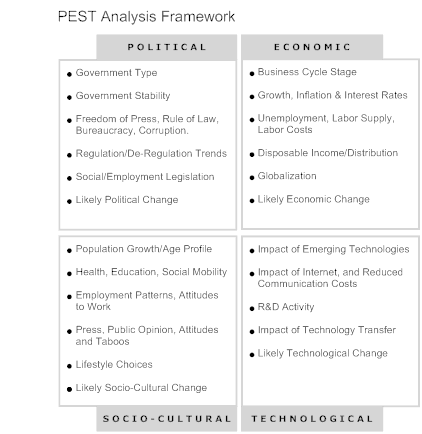
PEST Analysis is a simple, useful and widely-used tool that helps you understand the "big picture" of your Political, Economic, Socio-Cultural and Technological environment. As such, it is used by business leaders worldwide to build their vision of the future.
It is important for these reasons:
First, by making effective use of PEST Analysis, you ensure that what you are doing is aligned positively with the powerful forces of change that are affecting our world. By taking advantage of change, you are much more likely to be successful than if your activities oppose it.
Second, good use of PEST Analysis helps you avoid taking action that is doomed to failure from the outset, for reasons beyond your control.
Third, PEST is useful when you start operating in a new country or region. Use of PEST helps you break free of unconscious assumptions, and helps you quickly adapt to the realities of the new environment.
Political:
- Government type and stability.
- Freedom of press, rule of law and levels of bureaucracy and corruption.
- Regulation and de-regulation trends.
- Social and employment legislation.
- Tax policy, and trade and tariff controls.
- Environmental and consumer-protection legislation.
- Likely changes in the political environment.
Economic:
- Stage of business cycle.
- Current and project economic growth, inflation and interest rates.
- Unemployment and labor supply.
- Labor costs.
- Levels of disposable income and income distribution.
- Impact of globalization.
- Likely impact of technological or other change on the economy.
- Likely changes in the economic environment.
Socio-Cultural:
- Population growth rate and age profile.
- Population health, education and social mobility, and attitudes to these.
- Population employment patterns, job market freedom and attitudes to work.
- Press attitudes, public opinion, social attitudes and social taboos.
- Lifestyle choices and attitudes to these.
- Socio-cultural changes.
- Technological Environment:
Impact of emerging technologies.
- Impact of Internet, reduction in communications costs and increased remote working.
- Research and development activity.
- Impact of technology transfer.
Other forms of PEST - PESTLE, PESTLIED, STEEPLE and SLEPT:
Some people prefer to use different flavors of PEST Analysis, using other factors for different situations. The variants are:
PESTLE/PESTEL: Political, Economic, Sociological, Technological, Legal, Environmental.
PESTLIED: Political, Economic, Social, Technological, Legal, International, Environmental, Demographic.
STEEPLE: Social/Demographic, Technological, Economic, Environmental, Political, Legal, Ethical.
SLEPT: Social, Legal, Economic, Political, Technological.
Source: http://www.mindtools.com/pages/article/newTMC_09.htm
The Five Competitive Forces - by Michael E. Porter
Bargaining Power of Suppliers
The term 'suppliers' comprises all sources for inputs that are needed in order to provide goods or services.
Supplier bargaining power is likely to be high when:
•The market is dominated by a few large suppliers rather than a fragmented source of supply,
•There are no substitutes for the particular input,
•The suppliers customers are fragmented, so their bargaining power is low,
•The switching costs from one supplier to another are high,
•There is the possibility of the supplier integrating forwards in order to obtain higher prices and margins. This threat is especially high when
•The buying industry has a higher profitability than the supplying industry,
•Forward integration provides economies of scale for the supplier,
•The buying industry hinders the supplying industry in their development (e.g. reluctance to accept new releases of products),
•The buying industry has low barriers to entry.
In such situations, the buying industry often faces a high pressure on margins from their suppliers. The relationship to powerful suppliers can potentially reduce strategic options for the organization.
Bargaining Power of Customers
Similarly, the bargaining power of customers determines how much customers can impose pressure on margins and volumes.
Customers bargaining power is likely to be high when
•They buy large volumes, there is a concentration of buyers,
•The supplying industry comprises a large number of small operators
•The supplying industry operates with high fixed costs,
•The product is undifferentiated and can be replaces by substitutes,
•Switching to an alternative product is relatively simple and is not related to high costs,
•Customers have low margins and are price-sensitive,
•Customers could produce the product themselves,
•The product is not of strategical importance for the customer,
•The customer knows about the production costs of the product
•There is the possibility for the customer integrating backwards.
Threat of New Entrants
The competition in an industry will be the higher, the easier it is for other companies to enter this industry. In such a situation, new entrants could change major determinants of the market environment (e.g. market shares, prices, customer loyalty) at any time. There is always a latent pressure for reaction and adjustment for existing players in this industry.
The threat of new entries will depend on the extent to which there are barriers to entry. These are typically:-
•Economies of scale (minimum size requirements for profitable operations),
•High initial investments and fixed costs,
•Cost advantages of existing players due to experience curve effects of operation with fully depreciated assets,
•Brand loyalty of customers
•Protected intellectual property like patents, licenses etc,
•Scarcity of important resources, e.g. qualified expert staff
•Access to raw materials is controlled by existing players,
•Distribution channels are controlled by existing players,
•Existing players have close customer relations, e.g. from long-term service contracts,
•High switching costs for customers
•Legislation and government action
Threat of Substitutes
A threat from substitutes exists if there are alternative products with lower prices of better performance parameters for the same purpose. They could potentially attract a significant proportion of market volume and hence reduce the potential sales volume for existing players. This category also relates to complementary products.
Similarly to the threat of new entrants, the treat of substitutes is determined by factors like:-
•Brand loyalty of customers,
•Close customer relationships,
•Switching costs for customers,
•The relative price for performance of substitutes,
•Current trends.
Competitive Rivalry between Existing Players
This force describes the intensity of competition between existing players (companies) in an industry. High competitive pressure results in pressure on prices, margins, and hence, on profitability for every single company in the industry.
Competition between existing players is likely to be high when:-
•There are many players of about the same size,
•Players have similar strategies
•There is not much differentiation between players and their products, hence, there is much price competition
•Low market growth rates (growth of a particular company is possible only at the expense of a competitor),
•Barriers for exit are high (e.g. expensive and highly specialized equipment).
Influencing the Power of Five Forces
After the analysis of current and potential future state of the five competitive forces, managers can search for options to influence these forces in their organization’s interest. Although industry-specific business models will limit options, the own strategy can change the impact of competitive forces on the organization. The objective is to reduce the power of competitive forces.
The following summary provides some solutions. They are of general nature. Hence, they have to be adjusted to each organization’s specific situation. The options of an organization are determined not only by the external market environment, but also by its own internal resources, competences and objectives.
Reducing the Bargaining Power of Suppliers
- Partnering
- Supply chain management
- Supply chain training
- Increase dependency
- Build knowledge of supplier costs and methods
- Take over a supplier
Reducing the Bargaining Power of Customers
- Partnering
- Supply chain management
- Increase loyalty
- Increase incentives and value added
- Move purchase decision away from price
- Cut put powerful intermediaries (go directly to customer)
Reducing the Treat of New Entrants
- Increase minimum efficient scales of operations
- Create a marketing / brand image (loyalty as a barrier)
- Patents, protection of intellectual property
- Alliances with linked products / services
- Tie up with suppliers
- Tie up with distributors
- Retaliation tactics
Reducing the Threat of Substitutes
- Legal actions
- Increase switching costs
- Alliances
- Customer surveys to learn about their preferences
- Enter substitute market and influence from within
- Accentuate differences (real or perceived)
Reducing the Competitive Rivalry between Existing Players
- Avoid price competition
- Differentiate your product
- Buy out competition
- Reduce industry over-capacity
- Focus on different segments
- Communicate with competitors
Source: http://www.mindtools.com/pages/article/newTMC_08.htm
Subscribe to:
Posts (Atom)