The term ‘Value Chain’ was used by Michael Porter in his book "Competitive Advantage: Creating and Sustaining superior Performance" (1985). The value chain analysis describes the activities the organization performs and links them to the organizations competitive position.
Value chain analysis describes the activities within and around an organization, and relates them to an analysis of the competitive strength of the organization. Therefore, it evaluates which value each particular
activity adds to the organizations products or services. This idea was built upon the insight that an organization is more than a random compilation of machinery, equipment, people and money.
Only if these things are arranged into systems and systematic activates it will become possible to produce something for which customers are willing to pay a price. Porter argues that the ability to perform particular activities and to manage the linkages between these activities is a source of competitive advantage.
Porter distinguishes between primary activities and support activities. Primary activities are directly concerned with the creation or delivery of a product or service. They can be grouped into five main areas: inbound logistics, operations, outbound logistics, marketing and sales, and service. Each of these primary activities is linked to support activities which help to improve their effectiveness or efficiency.
There are four main areas of support activities: procurement, technology development (including R&D), human resource management, and infrastructure (systems for planning, finance, quality, information management etc.).
The term 'Margin' implies that organizations realize a profit margin that depends on their ability to manage the linkages between all activities in the value chain. In other words, the organization is able to deliver a product / service for which the customer is willing to pay more than the sum of the costs of all activities in the value chain.
The linkages are flows of information, goods and services, as well as systems and processes for adjusting activities. Their importance is best illustrated with some simple examples:
Only if the Marketing & Sales function delivers sales forecasts for the next period to all other departments in time and in reliable accuracy, procurement will be able to order the necessary material for the
correct date. And only if procurement does a good job and forwards order information to inbound logistics, only than operations will be able to schedule production in a way that guarantees the delivery of products in a timely and effective manner – as pre-determined by marketing.
In the result, the linkages are about seamless cooperation and information flow between the value chain activities.
In most industries, it is rather unusual that a single company performs all activities from product design, production of components, and final assembly to delivery to the final user by itself. Most often, organizations are elements of a value system or supply chain. Hence, value chain analysis should cover the whole value system in which the organization operates.
Within the whole value system, there is only a certain value of profit margin available. This is the difference of the final price the customer pays and the sum of all costs incurred with the production and delivery of the product/service (e.g. raw material, energy etc.). It depends on the structure of the value system, how this margin spreads across the suppliers, producers, distributors, customers, and other
elements of the value system. Each member of the system will use its market position and negotiating power to get a higher proportion of this margin. Nevertheless, members of a value system can cooperate to improve their efficiency and to reduce their costs in order to achieve a higher total margin to the benefit of all of them (e.g. by reducing stocks in a Just-In-Time system).
A typical value chain analysis can be performed in the following steps:
1. Analysis of own value chain – which costs are related to every single activity
2. Analysis of customers value chains – how does our product fit into their value chain
3. Identification of potential cost advantages in comparison with competitors
4. Identification of potential value added for the customer – how can our product add value to the customers value chain (e.g. lower costs or higher performance) – where does the customer see such potential Organizations Value.

Sunday, April 15, 2012

Monday, October 17, 2011
Leadership Models
Leadership models help us to understand what makes leaders act the way they do. The ideal is not to lock yourself in to a type of behavior discussed in the model, but to realize that every situation calls for a different approach or behavior to be taken. Two models will be discussed, the Four Framework Approach and the Managerial Grid.
Four Framework Approach
In the Four Framework Approach, Bolman and Deal (1991) suggest that leaders display leadership behaviors in one of four types of frameworks: Structural, Human Resource, Political, or Symbolic.

This model suggests that leaders can be put into one of these four categories and there are times when one approach is appropriate and times when it would not be. That is, any style can be effective or ineffective, depending upon the situation. Relying on only one of these approaches would be inadequate, thus we should strive to be conscious of all four approaches, and not just depend on one or two. For example, during a major organization change, a Structural leadership style may be more effective than a Symbolic leadership style; during a period when strong growth is needed, the Symbolic approach may be better. We also need to understand ourselves as each of us tends to have a preferred approach. We need to be conscious of this at all times and be aware of the limitations of just favoring one approach.
Structural Framework
In an effective leadership situation, the leader is a social architect whose leadership style is analysis and design. While in an ineffective leadership situation, the leader is a petty tyrant whose leadership style is details. Structural Leaders focus on structure, strategy, environment, implementation, experimentation, and adaptation.
Human Resource Framework
In an effective leadership situation, the leader is a catalyst and servant whose leadership style is support, advocating, and empowerment. while in an ineffective leadership situation, the leader is a pushover, whose leadership style is abdication and fraud. Human Resource Leaders believe in people and communicate that belief; they are visible and accessible; they empower, increase participation, support, share information, and move decision making down into the organization.
Political Framework
In an effective leadership situation, the leader is an advocate, whose leadership style is coalition and building. While in an ineffective leadership situation, the leader is a hustler, whose leadership style is manipulation. Political leaders clarify what they want and what they can get; they assess the distribution of power and interests; they build linkages to other stakeholders, use persuasion first, then use negotiation and coercion only if necessary.
Symbolic Framework
In an effective leadership situation, the leader is a prophet, whose leadership style is inspiration. While in an ineffective leadership situation, the leader is a fanatic or fool, whose leadership style is smoke and mirrors. Symbolic leaders view organizations as a stage or theater to play certain roles and give impressions; these leaders use symbols to capture attention; they try to frame experience by providing plausible interpretations of experiences; they discover and communicate a vision.
Managerial Grid
The Blake and Mouton Managerial Grid, also known as the Leadership Grid (1985) uses two axis:
1."Concern for people" is plotted using the vertical axis
2."Concern for task or results" is plotted along the horizontal axis.
They both have a range of 0 to 9. The notion that just two dimensions can describe a managerial behavior has the attraction of simplicity. These two dimensions can be drawn as a graph or grid:

Most people fall somewhere near the middle of the two axis — Middle of the Road. But, by going to the extremes, that is, people who score on the far end of the scales, we come up with four types of leaders:
◦Authoritarian — strong on tasks, weak on people skills
◦Country Club — strong on people skills, weak on tasks
◦Impoverished — weak on tasks, weak on people skills
◦Team Leader — strong on tasks, strong on people skills
The goal is to be at least in the Middle of the Road but preferably a Team Leader — that is, to score at least between a 5,5 to 9,9. In addition, a good leader operates at the extreme ends of the two scales, depending upon the situation.
Authoritarian Leader (high task, low relationship)
Leaders who get this rating are very much task oriented and are hard on their workers (autocratic). There is little or no allowance for cooperation or collaboration. Heavily task oriented people display these characteristics: they are very strong on schedules; they expect people to do what they are told without question or debate; when something goes wrong they tend to focus on who is to blame rather than concentrate on exactly what is wrong and how to prevent it; they are intolerant of what they see as dissent (it may just be someone's creativity), so it is difficult for their subordinates to contribute or develop.
Team Leader (high task, high relationship)
These leaders lead by positive example and endeavor to foster a team environment in that all team members can reach their highest potential, both as team members and as people. They encourage the team to reach team goals as effectively as possible, while also working tirelessly to strengthen the bonds among the various members. They normally form and lead some of the most productive teams.
Country Club Leader (low task, high relationship)
These leaders predominantly use reward power to maintain discipline and to encourage the team to accomplish its goals. Conversely, they are almost incapable of employing the more punitive coercive and legitimate powers. This inability results from fear that using such powers could jeopardize relationships with the other team members.
Impoverished Leader (low task, low relationship)
These leaders use a “delegate and disappear” management style. Since they are not committed to either task accomplishment or maintenance; they essentially allow their team to do whatever it wishes and prefer to detach themselves from the team process by allowing the team to suffer from a series of power struggles.
The most desirable place for a leader to be along the two axes at most times would be a 9 on task and a 9 on people — the Team Leader. However, do not entirely dismiss the other three. Certain situations might call for one of the other three to be used at times. For example, by playing the Impoverished Leader, you allow your team to gain self-reliance. Be an Authoritarian Leader to instill a sense of discipline in an unmotivated worker. By carefully studying the situation and the forces affecting it, you will know at what points along the axes you need to be in order to achieve the desired result.
Four Framework Approach
In the Four Framework Approach, Bolman and Deal (1991) suggest that leaders display leadership behaviors in one of four types of frameworks: Structural, Human Resource, Political, or Symbolic.

This model suggests that leaders can be put into one of these four categories and there are times when one approach is appropriate and times when it would not be. That is, any style can be effective or ineffective, depending upon the situation. Relying on only one of these approaches would be inadequate, thus we should strive to be conscious of all four approaches, and not just depend on one or two. For example, during a major organization change, a Structural leadership style may be more effective than a Symbolic leadership style; during a period when strong growth is needed, the Symbolic approach may be better. We also need to understand ourselves as each of us tends to have a preferred approach. We need to be conscious of this at all times and be aware of the limitations of just favoring one approach.
Structural Framework
In an effective leadership situation, the leader is a social architect whose leadership style is analysis and design. While in an ineffective leadership situation, the leader is a petty tyrant whose leadership style is details. Structural Leaders focus on structure, strategy, environment, implementation, experimentation, and adaptation.
Human Resource Framework
In an effective leadership situation, the leader is a catalyst and servant whose leadership style is support, advocating, and empowerment. while in an ineffective leadership situation, the leader is a pushover, whose leadership style is abdication and fraud. Human Resource Leaders believe in people and communicate that belief; they are visible and accessible; they empower, increase participation, support, share information, and move decision making down into the organization.
Political Framework
In an effective leadership situation, the leader is an advocate, whose leadership style is coalition and building. While in an ineffective leadership situation, the leader is a hustler, whose leadership style is manipulation. Political leaders clarify what they want and what they can get; they assess the distribution of power and interests; they build linkages to other stakeholders, use persuasion first, then use negotiation and coercion only if necessary.
Symbolic Framework
In an effective leadership situation, the leader is a prophet, whose leadership style is inspiration. While in an ineffective leadership situation, the leader is a fanatic or fool, whose leadership style is smoke and mirrors. Symbolic leaders view organizations as a stage or theater to play certain roles and give impressions; these leaders use symbols to capture attention; they try to frame experience by providing plausible interpretations of experiences; they discover and communicate a vision.
Managerial Grid
The Blake and Mouton Managerial Grid, also known as the Leadership Grid (1985) uses two axis:
1."Concern for people" is plotted using the vertical axis
2."Concern for task or results" is plotted along the horizontal axis.
They both have a range of 0 to 9. The notion that just two dimensions can describe a managerial behavior has the attraction of simplicity. These two dimensions can be drawn as a graph or grid:

Most people fall somewhere near the middle of the two axis — Middle of the Road. But, by going to the extremes, that is, people who score on the far end of the scales, we come up with four types of leaders:
◦Authoritarian — strong on tasks, weak on people skills
◦Country Club — strong on people skills, weak on tasks
◦Impoverished — weak on tasks, weak on people skills
◦Team Leader — strong on tasks, strong on people skills
The goal is to be at least in the Middle of the Road but preferably a Team Leader — that is, to score at least between a 5,5 to 9,9. In addition, a good leader operates at the extreme ends of the two scales, depending upon the situation.
Authoritarian Leader (high task, low relationship)
Leaders who get this rating are very much task oriented and are hard on their workers (autocratic). There is little or no allowance for cooperation or collaboration. Heavily task oriented people display these characteristics: they are very strong on schedules; they expect people to do what they are told without question or debate; when something goes wrong they tend to focus on who is to blame rather than concentrate on exactly what is wrong and how to prevent it; they are intolerant of what they see as dissent (it may just be someone's creativity), so it is difficult for their subordinates to contribute or develop.
Team Leader (high task, high relationship)
These leaders lead by positive example and endeavor to foster a team environment in that all team members can reach their highest potential, both as team members and as people. They encourage the team to reach team goals as effectively as possible, while also working tirelessly to strengthen the bonds among the various members. They normally form and lead some of the most productive teams.
Country Club Leader (low task, high relationship)
These leaders predominantly use reward power to maintain discipline and to encourage the team to accomplish its goals. Conversely, they are almost incapable of employing the more punitive coercive and legitimate powers. This inability results from fear that using such powers could jeopardize relationships with the other team members.
Impoverished Leader (low task, low relationship)
These leaders use a “delegate and disappear” management style. Since they are not committed to either task accomplishment or maintenance; they essentially allow their team to do whatever it wishes and prefer to detach themselves from the team process by allowing the team to suffer from a series of power struggles.
The most desirable place for a leader to be along the two axes at most times would be a 9 on task and a 9 on people — the Team Leader. However, do not entirely dismiss the other three. Certain situations might call for one of the other three to be used at times. For example, by playing the Impoverished Leader, you allow your team to gain self-reliance. Be an Authoritarian Leader to instill a sense of discipline in an unmotivated worker. By carefully studying the situation and the forces affecting it, you will know at what points along the axes you need to be in order to achieve the desired result.
Tuesday, October 4, 2011
Concepts of Leadership
Concepts of Leadership
Good leaders are made not born. Good and effective leaders develop through a never ending process of self-study, education, training, and experience. In order to inspire others into higher levels of teamwork, there are certain things you must be, know, and, do. These do not come naturally, but are acquired through continual work and study. Good leaders are continually working and studying to improve their leadership skills; they are NOT resting on their laurels.
What is leadership?
Leadership is a process by which a person influences others to accomplish an objective and directs the organization in a way that makes it more cohesive and coherent. Leadership is a process whereby an individual influences a group of individuals to achieve a common goal.
Leaders carry out leadership process by applying their leadership knowledge and skills (Process Leadership). Actions of leaders are influence by the traits they possessed (Traits Leadership).

While leadership is learned, the skills and knowledge processed by the leader can be influenced by his or hers attributes or traits, such as beliefs, values, ethics, and character. Knowledge and skills contribute directly to the process of leadership, while the other attributes give the leader certain characteristics that make him or her unique.
Skills, knowledge, and attributes make the Leader.
Four Factors of Leadership.
Leader
You must have an honest understanding of who you are, what you know, and what you can do. Also, note that it is the followers, not the leader or someone else who determines if the leader is successful. If they do not trust or lack confidence in their leader, then they will be uninspired. To be successful you have to convince your followers, not yourself or your superiors, that you are worthy of being followed.
Followers
Different people require different styles of leadership. For example, a new hire requires more supervision than an experienced employee. A person who lacks motivation requires a different approach than one with a high degree of motivation. You must know your people! The fundamental starting point is having a good understanding of human nature, such as needs, emotions, and motivation. You must come to know your employees' be, know, and do attributes.
Communication
You lead through two-way communication. Much of it is nonverbal. For instance, when you “set the example,” that communicates to your people that you would not ask them to perform anything that you would not be willing to do. What and how you communicate either builds or harms the relationship between you and your employees.
Situation
All situations are different. What you do in one situation will not always work in another. You must use your judgment to decide the best course of action and the leadership style needed for each situation. For example, you may need to confront an employee for inappropriate behavior, but if the confrontation is too late or too early, too harsh or too weak, then the results may prove ineffective.
Also note that the situation normally has a greater effect on a leader's action than his or her traits. This is because while traits may have an impressive stability over a period of time, they have little consistency across situations (Mischel, 1968). This is why a number of leadership scholars think the Process Theory of Leadership is a more accurate than the Trait Theory of Leadership.
Various forces will affect these four factors. Examples of forces are your relationship with your seniors, the skill of your followers, the informal leaders within your organization, and how your organization is organized.
Good leaders are made not born. Good and effective leaders develop through a never ending process of self-study, education, training, and experience. In order to inspire others into higher levels of teamwork, there are certain things you must be, know, and, do. These do not come naturally, but are acquired through continual work and study. Good leaders are continually working and studying to improve their leadership skills; they are NOT resting on their laurels.
What is leadership?
Leadership is a process by which a person influences others to accomplish an objective and directs the organization in a way that makes it more cohesive and coherent. Leadership is a process whereby an individual influences a group of individuals to achieve a common goal.
Leaders carry out leadership process by applying their leadership knowledge and skills (Process Leadership). Actions of leaders are influence by the traits they possessed (Traits Leadership).

While leadership is learned, the skills and knowledge processed by the leader can be influenced by his or hers attributes or traits, such as beliefs, values, ethics, and character. Knowledge and skills contribute directly to the process of leadership, while the other attributes give the leader certain characteristics that make him or her unique.
Skills, knowledge, and attributes make the Leader.
Four Factors of Leadership.
Leader
You must have an honest understanding of who you are, what you know, and what you can do. Also, note that it is the followers, not the leader or someone else who determines if the leader is successful. If they do not trust or lack confidence in their leader, then they will be uninspired. To be successful you have to convince your followers, not yourself or your superiors, that you are worthy of being followed.
Followers
Different people require different styles of leadership. For example, a new hire requires more supervision than an experienced employee. A person who lacks motivation requires a different approach than one with a high degree of motivation. You must know your people! The fundamental starting point is having a good understanding of human nature, such as needs, emotions, and motivation. You must come to know your employees' be, know, and do attributes.
Communication
You lead through two-way communication. Much of it is nonverbal. For instance, when you “set the example,” that communicates to your people that you would not ask them to perform anything that you would not be willing to do. What and how you communicate either builds or harms the relationship between you and your employees.
Situation
All situations are different. What you do in one situation will not always work in another. You must use your judgment to decide the best course of action and the leadership style needed for each situation. For example, you may need to confront an employee for inappropriate behavior, but if the confrontation is too late or too early, too harsh or too weak, then the results may prove ineffective.
Also note that the situation normally has a greater effect on a leader's action than his or her traits. This is because while traits may have an impressive stability over a period of time, they have little consistency across situations (Mischel, 1968). This is why a number of leadership scholars think the Process Theory of Leadership is a more accurate than the Trait Theory of Leadership.
Various forces will affect these four factors. Examples of forces are your relationship with your seniors, the skill of your followers, the informal leaders within your organization, and how your organization is organized.
Wednesday, August 10, 2011
Business Strategy: Value Chain Analysis
Value Chain Analysis describes the activities that take place in a business and relates them to an analysis of the competitive strength of the business. Influential work by Michael Porter suggested that the activities of a business could be grouped under two headings:
(1) Primary Activities - those that are directly concerned with creating and delivering a product (e.g. component assembly); and
(2) Support Activities, which whilst they are not directly involved in production, may increase effectiveness or efficiency (e.g. human resource management). It is rare for a business to undertake all primary and support activities.
Value Chain Analysis is one way of identifying which activities are best undertaken by a business and which are best provided by others ("out sourced").
Linking Value Chain Analysis to Competitive Advantage
What activities a business undertakes is directly linked to achieving competitive advantage. For example, a business which wishes to outperform its competitors through differentiating itself through higher quality will have to perform its value chain activities better than the opposition. By contrast, a strategy based on seeking cost leadership will require a reduction in the costs associated with the value chain activities, or a reduction in the total amount of resources used.
Primary Activities
Primary value chain activities include:
Primary Activity
Inbound logistics: All those activities concerned with receiving and storing externally sourced materials.
Operations: The manufacture of products and services - the way in which resource inputs (e.g. materials) are converted to outputs (e.g. products)
Outbound logistics: All those activities associated with getting finished goods and services to buyers
Marketing and sales: Essentially an information activity - informing buyers and consumers about products and services (benefits, use, price etc.)
Service" All those activities associated with maintaining product performance after the product has been sold.
Support Activities
Support activities include:
Secondary Activities
Procurement: This concerns how resources are acquired for a business (e.g. sourcing and negotiating with materials suppliers)
Human Resource Management: Those activities concerned with recruiting, developing, motivating and rewarding the workforce of a business.
Technology Development: Activities concerned with managing information processing and the development and protection of "knowledge" in a business .
Infrastructure: Concerned with a wide range of support systems and functions such as finance, planning, quality control and general senior management .
Steps in Value Chain Analysis
Value chain analysis can be broken down into a three sequential steps:
(1) Break down a market/organisation into its key activities under each of the major headings in the model;
(2) Assess the potential for adding value via cost advantage or differentiation, or identify current activities where a business appears to be at a competitive disadvantage;
(3) Determine strategies built around focusing on activities where competitive advantage can be sustained
(1) Primary Activities - those that are directly concerned with creating and delivering a product (e.g. component assembly); and
(2) Support Activities, which whilst they are not directly involved in production, may increase effectiveness or efficiency (e.g. human resource management). It is rare for a business to undertake all primary and support activities.
Value Chain Analysis is one way of identifying which activities are best undertaken by a business and which are best provided by others ("out sourced").
Linking Value Chain Analysis to Competitive Advantage
What activities a business undertakes is directly linked to achieving competitive advantage. For example, a business which wishes to outperform its competitors through differentiating itself through higher quality will have to perform its value chain activities better than the opposition. By contrast, a strategy based on seeking cost leadership will require a reduction in the costs associated with the value chain activities, or a reduction in the total amount of resources used.
Primary Activities
Primary value chain activities include:
Primary Activity
Inbound logistics: All those activities concerned with receiving and storing externally sourced materials.
Operations: The manufacture of products and services - the way in which resource inputs (e.g. materials) are converted to outputs (e.g. products)
Outbound logistics: All those activities associated with getting finished goods and services to buyers
Marketing and sales: Essentially an information activity - informing buyers and consumers about products and services (benefits, use, price etc.)
Service" All those activities associated with maintaining product performance after the product has been sold.
Support Activities
Support activities include:
Secondary Activities
Procurement: This concerns how resources are acquired for a business (e.g. sourcing and negotiating with materials suppliers)
Human Resource Management: Those activities concerned with recruiting, developing, motivating and rewarding the workforce of a business.
Technology Development: Activities concerned with managing information processing and the development and protection of "knowledge" in a business .
Infrastructure: Concerned with a wide range of support systems and functions such as finance, planning, quality control and general senior management .
Steps in Value Chain Analysis
Value chain analysis can be broken down into a three sequential steps:
(1) Break down a market/organisation into its key activities under each of the major headings in the model;
(2) Assess the potential for adding value via cost advantage or differentiation, or identify current activities where a business appears to be at a competitive disadvantage;
(3) Determine strategies built around focusing on activities where competitive advantage can be sustained
Business Strategy: Mc Kinsey Growth Pyramid
Introduction
This model is similar in some respects to the well-established Ansoff Model. However, it looks at growth strategy from a slightly different perspective.
The McKinsey model argues that businesses should develop their growth strategies based on:
• Operational skills
• Privileged assets
• Growth skills
• Special relationships
Growth can be achieved by looking at business opportunities along several dimensions, summarised in the diagram below:

• Operational skills are the “core competences” that a business has which can provide the foundation for a growth strategy. For example, the business may have strong competencies in customer service; distribution, technology.
• Privileged assets are those assets held by the business that are hard to replicate by competitors. For example, in a direct marketing-based business these assets might include a particularly large customer database, or a well-established brand.
• Growth skills are the skills that businesses need if they are to successfully “manage” a growth strategy. These include the skills of new product development, or negotiating and integrating acquisitions.
• Special relationships are those that can open up new options. For example, the business may have specially string relationships with trade bodies in the industry that can make the process of growing in export markets easier than for the competition.
The model outlines seven ways of achieving growth, which are summarised below:
Existing products to existing customers
The lowest-risk option; try to increase sales to the existing customer base; this is about increasing the frequency of purchase and maintaining customer loyalty
Existing products to new customers
Taking the existing customer base, the objective is to find entirely new products that these customers might buy, or start to provide products that existing customers currently buy from competitors
New products and services
A combination of Ansoff’s market development & diversification strategy – taking a risk by developing and marketing new products. Some of these can be sold to existing customers – who may trust the business (and its brands) to deliver; entirely new customers may need more persuasion
New delivery approaches
This option focuses on the use of distribution channels as a possible source of growth. Are there ways in which existing products and services can be sold via new or emerging channels which might boost sales?
New geographies
With this method, businesses are encouraged to consider new geographic areas into which to sell their products. Geographical expansion is one of the most powerful options for growth – but also one of the most difficult.
New industry structure
This option considers the possibility of acquiring troubled competitors or consolidating the industry through a general acquisition programme
New competitive arenas
This option requires a business to think about opportunities to integrate vertically or consider whether the skills of the business could be used in other industries.
This model is similar in some respects to the well-established Ansoff Model. However, it looks at growth strategy from a slightly different perspective.
The McKinsey model argues that businesses should develop their growth strategies based on:
• Operational skills
• Privileged assets
• Growth skills
• Special relationships
Growth can be achieved by looking at business opportunities along several dimensions, summarised in the diagram below:

• Operational skills are the “core competences” that a business has which can provide the foundation for a growth strategy. For example, the business may have strong competencies in customer service; distribution, technology.
• Privileged assets are those assets held by the business that are hard to replicate by competitors. For example, in a direct marketing-based business these assets might include a particularly large customer database, or a well-established brand.
• Growth skills are the skills that businesses need if they are to successfully “manage” a growth strategy. These include the skills of new product development, or negotiating and integrating acquisitions.
• Special relationships are those that can open up new options. For example, the business may have specially string relationships with trade bodies in the industry that can make the process of growing in export markets easier than for the competition.
The model outlines seven ways of achieving growth, which are summarised below:
Existing products to existing customers
The lowest-risk option; try to increase sales to the existing customer base; this is about increasing the frequency of purchase and maintaining customer loyalty
Existing products to new customers
Taking the existing customer base, the objective is to find entirely new products that these customers might buy, or start to provide products that existing customers currently buy from competitors
New products and services
A combination of Ansoff’s market development & diversification strategy – taking a risk by developing and marketing new products. Some of these can be sold to existing customers – who may trust the business (and its brands) to deliver; entirely new customers may need more persuasion
New delivery approaches
This option focuses on the use of distribution channels as a possible source of growth. Are there ways in which existing products and services can be sold via new or emerging channels which might boost sales?
New geographies
With this method, businesses are encouraged to consider new geographic areas into which to sell their products. Geographical expansion is one of the most powerful options for growth – but also one of the most difficult.
New industry structure
This option considers the possibility of acquiring troubled competitors or consolidating the industry through a general acquisition programme
New competitive arenas
This option requires a business to think about opportunities to integrate vertically or consider whether the skills of the business could be used in other industries.
Thursday, August 4, 2011
Game Theory as Strategic Management Tool
Game Theory
Game theory is a reasoned attempt to predict behavior. It applies in situations where an individual's success in making choices depends on the choices of others.
Imagine if you can predict or anticipate what your competitors are going to do, you probably be in a competitive position to outdo your rivals by implementing better moves to conquer the market. This is the essence of Game Theory.
Game theory studies competitive and cooperative behavior in strategic environments, where the fortunes of several players are intertwined. It provides methods for identifying optimal strategies and predicting the outcomes of strategic interactions.
The field of game theory began around 1900 when mathematicians began asking whether there are optimal strategies for parlor games such as chess and poker, and, if so, what these strategies might look like. The first comprehensive formulation of the subject came in 1944 with the publication of the book Theory of Games and Economic Behavior by famous mathematician John von Neumann and eminent economist Oskar Morgenstern. As its title indicates, this book also marked the beginning of the application of game theory to economics.
Since then, game theory has been applied to many other fields, including political science, military strategy, law,
computer science, and biology, among other areas.
Game Theory Strategy
The idea of business as a game, in the sense that a move by one player sparks off moves by others, runs through much strategic thinking. It is borrowed from a branch of economics (game theory) in which no economic agent (individual or corporate) is an island, living and acting independently of others.
In sectors where firms compete fiercely for market share and customer loyalty, this stylised progression of moves closely parallels actual behaviour.
Seeing business life as a never-ending series of games, each of which has a winner and a loser, can be a handicap. In business negotiations, for example, with external suppliers or customers, or with trade unions or colleagues, it can be unhelpful if participants see it only in terms of a victory or a loss. For that way one party has to walk away feeling bad about the outcome. In some non-western cultures the aim is different. The negotiation process is steered towards a win-win outcome, one with which both parties can be reasonably content.
Game theory is a reasoned attempt to predict behavior. It applies in situations where an individual's success in making choices depends on the choices of others.
Imagine if you can predict or anticipate what your competitors are going to do, you probably be in a competitive position to outdo your rivals by implementing better moves to conquer the market. This is the essence of Game Theory.
Game theory studies competitive and cooperative behavior in strategic environments, where the fortunes of several players are intertwined. It provides methods for identifying optimal strategies and predicting the outcomes of strategic interactions.
The field of game theory began around 1900 when mathematicians began asking whether there are optimal strategies for parlor games such as chess and poker, and, if so, what these strategies might look like. The first comprehensive formulation of the subject came in 1944 with the publication of the book Theory of Games and Economic Behavior by famous mathematician John von Neumann and eminent economist Oskar Morgenstern. As its title indicates, this book also marked the beginning of the application of game theory to economics.
Since then, game theory has been applied to many other fields, including political science, military strategy, law,
computer science, and biology, among other areas.
Game Theory Strategy
The idea of business as a game, in the sense that a move by one player sparks off moves by others, runs through much strategic thinking. It is borrowed from a branch of economics (game theory) in which no economic agent (individual or corporate) is an island, living and acting independently of others.
In sectors where firms compete fiercely for market share and customer loyalty, this stylised progression of moves closely parallels actual behaviour.
Seeing business life as a never-ending series of games, each of which has a winner and a loser, can be a handicap. In business negotiations, for example, with external suppliers or customers, or with trade unions or colleagues, it can be unhelpful if participants see it only in terms of a victory or a loss. For that way one party has to walk away feeling bad about the outcome. In some non-western cultures the aim is different. The negotiation process is steered towards a win-win outcome, one with which both parties can be reasonably content.
Saturday, July 30, 2011
Core Competencies Strategy
Core competencies are those capabilities that are critical to a business achieving competitive advantage. The starting point for analysing core competencies is recognising that competition between businesses is as much a race for competence mastery as it is for market position and market power. Senior management cannot focus on all activities of a business and the competencies required to undertake them. So the goal is for management to focus attention on competencies that really affect competitive advantage.
The main ideas about Core Competencies were developed by C K Prahalad and G Hamel. The central idea of core competency was that over time companies may develop key areas of expertise which are distinctive to that company and critical to the company's long term growth.
The core areas of expertise may be in any area but are most likely to develop in the critical, central areas of the company where the most value is added to its products.
Core Competencies are not seen as being fixed. Core Competencies should change in response to changes in the company's environment which is constantly changing. They are flexible and evolve over time. As a business evolves and adapts to new circumstances and opportunities, so its Core Competencies will have to adapt and change.
Identifying Core Competencies
Prahalad and Hamel suggest three factors to help identify core competencies in any business:
a. Provides potential access to a wide variety of markets: -
The key core competencies here are those that enable the creation of new products and services.
b. Makes a significant contribution to the perceived customer benefits of the end product: - Core competencies are the skills that enable a business to deliver a fundamental customer benefit.
c. Difficult for competitors to imitate: - A core competence should be "competitively unique" where the product is difficult to imitate.
Resources that are standardised or easily available will not enable a business to achieve a competitive advantage over rivals.
The main ideas about Core Competencies were developed by C K Prahalad and G Hamel. The central idea of core competency was that over time companies may develop key areas of expertise which are distinctive to that company and critical to the company's long term growth.
The core areas of expertise may be in any area but are most likely to develop in the critical, central areas of the company where the most value is added to its products.
Core Competencies are not seen as being fixed. Core Competencies should change in response to changes in the company's environment which is constantly changing. They are flexible and evolve over time. As a business evolves and adapts to new circumstances and opportunities, so its Core Competencies will have to adapt and change.
Identifying Core Competencies
Prahalad and Hamel suggest three factors to help identify core competencies in any business:
a. Provides potential access to a wide variety of markets: -
The key core competencies here are those that enable the creation of new products and services.
b. Makes a significant contribution to the perceived customer benefits of the end product: - Core competencies are the skills that enable a business to deliver a fundamental customer benefit.
c. Difficult for competitors to imitate: - A core competence should be "competitively unique" where the product is difficult to imitate.
Resources that are standardised or easily available will not enable a business to achieve a competitive advantage over rivals.
Monday, July 18, 2011
Critical Success Factors (CSF)
Critical Success Factors are the essential areas of activity that must be performed well if organization wants to achieve their mission, objectives or goals for your business or project.
Critical Success Factors helps to create a common point of reference to help you direct and measure the success of your business or project. As a common point of reference, CSFs help everyone in the team to know exactly what's most important. And this helps people perform their own work in the right context and so pull together towards the same overall aims.
The idea of CSFs was first presented by D. Ronald Daniel in the 1960s. It was then built on and popularized a decade later by John F. Rockart, of MIT's Sloan School of Management, and has since been used extensively to help businesses implement their strategies and projects.
Rockart defined CSFs as:
"The limited number of areas in which results, if they are satisfactory, will ensure successful competitive performance for the organization. They are the few key areas where things must go right for the business to flourish. If results in these areas are not adequate, the organization's efforts for the period will be less than desired."
He also concluded that CSFs are "areas of activity that should receive constant and careful attention from management."
Critical Success Factors are strongly related to the mission and strategic goals of your business or project. Whereas the mission and goals focus on the aims and what is to be achieved, Critical Success Factors focus on the most important areas and get to the very heart of both what is to be achieved and how you will achieve it.
Below are the summary steps that will help you identify the CSFs for your business or project:
Step One: Establish your business's or project's mission and strategic goals.
Step Two: For each strategic goal, ask yourself "what area of business or project activity is essential to achieve this goal?"
Step Three: Evaluate the list to find the absolute essential elements for achieving success – these are your Criticial Success Factors. As you identify and evaluate CSFs, you may uncover some new strategic objectives or more detailed objectives. So you may need to define your mission, objectives and CSFs iteratively.
Step Four: Identify how you will monitor and measure each of the CSFs
Step Five: Communicate your CSFs along with the other important elements of your business or project's strategy.
Step Six: Keep monitoring and reevaluating your CSFs to ensure you keep progressing towards your aims. Indeed, whilst CSFs are sometimes less tangible than measurable goals, it is useful to identify as specifically as possible how you can measure or monitor each one.
To make sure you consider all types of possible CSFs, you can use Rockart's CSF types as a checklist.
•Industry – these factors result from specific industry characteristics. These are the things that the organization must do to remain competitive.
•Environmental – these factors result from macro-environmental influences on an organization. Things like the business climate, the economy, competitors, and technological advancements are included in this category.
•Strategic – these factors result from the specific competitive strategy chosen by the organization. The way in which the company chooses to position themselves, market themselves, whether they are high volume low cost or low volume high cost producers, etc.
•Temporal – these factors result from the organization's internal forces. Specific barriers, challenges, directions, and influences will determine these CSFs
Source: www.mindtools.com
Critical Success Factors helps to create a common point of reference to help you direct and measure the success of your business or project. As a common point of reference, CSFs help everyone in the team to know exactly what's most important. And this helps people perform their own work in the right context and so pull together towards the same overall aims.
The idea of CSFs was first presented by D. Ronald Daniel in the 1960s. It was then built on and popularized a decade later by John F. Rockart, of MIT's Sloan School of Management, and has since been used extensively to help businesses implement their strategies and projects.
Rockart defined CSFs as:
"The limited number of areas in which results, if they are satisfactory, will ensure successful competitive performance for the organization. They are the few key areas where things must go right for the business to flourish. If results in these areas are not adequate, the organization's efforts for the period will be less than desired."
He also concluded that CSFs are "areas of activity that should receive constant and careful attention from management."
Critical Success Factors are strongly related to the mission and strategic goals of your business or project. Whereas the mission and goals focus on the aims and what is to be achieved, Critical Success Factors focus on the most important areas and get to the very heart of both what is to be achieved and how you will achieve it.
Below are the summary steps that will help you identify the CSFs for your business or project:
Step One: Establish your business's or project's mission and strategic goals.
Step Two: For each strategic goal, ask yourself "what area of business or project activity is essential to achieve this goal?"
Step Three: Evaluate the list to find the absolute essential elements for achieving success – these are your Criticial Success Factors. As you identify and evaluate CSFs, you may uncover some new strategic objectives or more detailed objectives. So you may need to define your mission, objectives and CSFs iteratively.
Step Four: Identify how you will monitor and measure each of the CSFs
Step Five: Communicate your CSFs along with the other important elements of your business or project's strategy.
Step Six: Keep monitoring and reevaluating your CSFs to ensure you keep progressing towards your aims. Indeed, whilst CSFs are sometimes less tangible than measurable goals, it is useful to identify as specifically as possible how you can measure or monitor each one.
To make sure you consider all types of possible CSFs, you can use Rockart's CSF types as a checklist.
•Industry – these factors result from specific industry characteristics. These are the things that the organization must do to remain competitive.
•Environmental – these factors result from macro-environmental influences on an organization. Things like the business climate, the economy, competitors, and technological advancements are included in this category.
•Strategic – these factors result from the specific competitive strategy chosen by the organization. The way in which the company chooses to position themselves, market themselves, whether they are high volume low cost or low volume high cost producers, etc.
•Temporal – these factors result from the organization's internal forces. Specific barriers, challenges, directions, and influences will determine these CSFs
Source: www.mindtools.com
Six Principles of Blue Ocean Strategy
There are six main principles that guide companies through the formulation and execution of their Blue Ocean Strategy in a systematic risk minimizing and opportunity maximizing manner.
The first four principles address Blue Ocean Strategy formulation:
1. Reconstruct market boundaries. This principle identifies the paths by which managers can systematically create uncontested market space across diverse industry domains, hence attenuating search risk. It teaches companies how to make the competition irrelevant by looking across the six conventional boundaries of competition to open up commercially important blue oceans. The six paths focus on looking across alternative industries, across strategic groups, across buyer groups, across complementary product and service offerings, across the functional-emotional orientation of an industry, and even across time.
2. Focus on the big picture, not the numbers. Illustrates how to design a company's strategic planning process to go beyond incremental improvements to create value innovations. It presents an alternative to the existing strategic planning process, which is often criticized as a number-crunching exercise that keeps companies locked into making incremental improvements. This principle tackles planning risk. Using a visualizing approach that drives managers to focus on the big picture rather than to be submerged in numbers and jargon, this principle proposes a four-step planning process whereby you can build a strategy that creates and captures blue ocean opportunities.
3. Reach beyond existing demand. To create the greatest market of new demand, managers must challenge the conventional practice of aiming for finer segmentation to better meet existing customer preferences. This practice often results in increasingly small target markets. Instead, this principle shows how to aggregate demand, not by focusing on the differences that separate customers but by building on the powerful commonalities across noncustomers to maximize the size of the blue ocean being created and new demand being unlocked, hence minimizing scale risk.
4. Get the strategic sequence right. This principle describes a sequence which companies should follow to ensure that the business model they build will be able to produce and maintain profitable growth. When companies meet the sequence of utility, price, cost and adoption requirements, they address the business model risk and the blue ocean idea they created will be a commercially viable one.
The remaining two principles address the execution risks of Blue Ocean Strategy.
5. Overcome key organizational hurdles. Tipping point leadership shows managers how to mobilize an organization to overcome the key organizational hurdles that block the implementation of a blue ocean strategy. This principle deals with organizational risk. It lays out how leaders and managers alike can surmount the cognitive, resource, motivational, and political hurdles in spite of limited time and resources in executing blue ocean strategy.
6. Build execution into strategy. By integrating execution into strategy making, people are motivated to act on and execute a blue ocean strategy in a sustained way deep in an organization. This principle introduces, what Kim & Mauborgne call, fair process. Because a blue ocean strategy perforce represents a departure from the status quo, fair process is required to facilitate both strategy making and execution by mobilizing people for the voluntary cooperation needed to execute blue ocean strategy. It deals with management risk associated with people's attitudes and behaviors.

Article Source: www.blueoceanstrategy.com
Picture Source: http://www.ecomaxmc.com/blog/?p=10
The first four principles address Blue Ocean Strategy formulation:
1. Reconstruct market boundaries. This principle identifies the paths by which managers can systematically create uncontested market space across diverse industry domains, hence attenuating search risk. It teaches companies how to make the competition irrelevant by looking across the six conventional boundaries of competition to open up commercially important blue oceans. The six paths focus on looking across alternative industries, across strategic groups, across buyer groups, across complementary product and service offerings, across the functional-emotional orientation of an industry, and even across time.
2. Focus on the big picture, not the numbers. Illustrates how to design a company's strategic planning process to go beyond incremental improvements to create value innovations. It presents an alternative to the existing strategic planning process, which is often criticized as a number-crunching exercise that keeps companies locked into making incremental improvements. This principle tackles planning risk. Using a visualizing approach that drives managers to focus on the big picture rather than to be submerged in numbers and jargon, this principle proposes a four-step planning process whereby you can build a strategy that creates and captures blue ocean opportunities.
3. Reach beyond existing demand. To create the greatest market of new demand, managers must challenge the conventional practice of aiming for finer segmentation to better meet existing customer preferences. This practice often results in increasingly small target markets. Instead, this principle shows how to aggregate demand, not by focusing on the differences that separate customers but by building on the powerful commonalities across noncustomers to maximize the size of the blue ocean being created and new demand being unlocked, hence minimizing scale risk.
4. Get the strategic sequence right. This principle describes a sequence which companies should follow to ensure that the business model they build will be able to produce and maintain profitable growth. When companies meet the sequence of utility, price, cost and adoption requirements, they address the business model risk and the blue ocean idea they created will be a commercially viable one.
The remaining two principles address the execution risks of Blue Ocean Strategy.
5. Overcome key organizational hurdles. Tipping point leadership shows managers how to mobilize an organization to overcome the key organizational hurdles that block the implementation of a blue ocean strategy. This principle deals with organizational risk. It lays out how leaders and managers alike can surmount the cognitive, resource, motivational, and political hurdles in spite of limited time and resources in executing blue ocean strategy.
6. Build execution into strategy. By integrating execution into strategy making, people are motivated to act on and execute a blue ocean strategy in a sustained way deep in an organization. This principle introduces, what Kim & Mauborgne call, fair process. Because a blue ocean strategy perforce represents a departure from the status quo, fair process is required to facilitate both strategy making and execution by mobilizing people for the voluntary cooperation needed to execute blue ocean strategy. It deals with management risk associated with people's attitudes and behaviors.

Article Source: www.blueoceanstrategy.com
Picture Source: http://www.ecomaxmc.com/blog/?p=10
Friday, July 8, 2011
The Marketing Environment - Environmental Forces Affecting Marketing
The marketing environment involves factors that, for the most part, are beyond the control of the company. Thus, the company must adapt to these factors. It is important to observe how the environment changes so that a firm can adapt its strategies appropriately to meet the needs and wants of the target markets.
Some of the environmental forces includes: -
Competition: Competitors often “creep” in and threaten to take away markets from firms. Note that while competition may be frustrating for the firm, it is good for consumers. Competition today is increasingly global in scope.
Economics: Some firms in particular are extremely vulnerable to changes in the economy. Consumers tend to put off buying a new car, going out to eat, or building new homes in bad times. In contrast, in good times, firms serving those needs may have difficulty keeping up with demand. In short, economic boom and bust affects demand for goods and services across different market segments.
Political: Businesses are very vulnerable to changes in the political situation. For example, because consumer groups lobbied the Parliament, more stringent rules were made on the terms of car leases. The tobacco industry is currently the target of much negative attention from government and public interest groups.
Legal: Firms are very vulnerable to changing laws and changing interpretations by the courts. McDonald’s, for example, has been sued by people who claim that eating the chain’s hamburgers caused them to get fat. Some impacts of the legal environment:
Firms are significantly limited in what they can do by various laws—some laws, for example, require that disclosures be made to consumers on the effective interest rates they pay on products bought on installment.
Changes in government's regulations and rules related to import and export of goods may have impact on firms across all sectors in the market.
Technological: Changes in technology may significantly influence the demand for a product. For example, the Internet is a major threat to travel agents.
Social: Changes in customs or demographics greatly influence firms. More women work outside the home today, so there is a greater demand for prepared foods. There are more unmarried singles today. This provides opportunities for some firms (e.g., fast food restaurants) but creates problems for others (e.g., manufacturers of high quality furniture that many people put off buying until marriage). Today, there are more “blended” families that result as parents remarry after divorce. These families are often strapped for money but may require “duplicate” items for children at each parent’s residence.
Some of the environmental forces includes: -
Competition: Competitors often “creep” in and threaten to take away markets from firms. Note that while competition may be frustrating for the firm, it is good for consumers. Competition today is increasingly global in scope.
Economics: Some firms in particular are extremely vulnerable to changes in the economy. Consumers tend to put off buying a new car, going out to eat, or building new homes in bad times. In contrast, in good times, firms serving those needs may have difficulty keeping up with demand. In short, economic boom and bust affects demand for goods and services across different market segments.
Political: Businesses are very vulnerable to changes in the political situation. For example, because consumer groups lobbied the Parliament, more stringent rules were made on the terms of car leases. The tobacco industry is currently the target of much negative attention from government and public interest groups.
Legal: Firms are very vulnerable to changing laws and changing interpretations by the courts. McDonald’s, for example, has been sued by people who claim that eating the chain’s hamburgers caused them to get fat. Some impacts of the legal environment:
Firms are significantly limited in what they can do by various laws—some laws, for example, require that disclosures be made to consumers on the effective interest rates they pay on products bought on installment.
Changes in government's regulations and rules related to import and export of goods may have impact on firms across all sectors in the market.
Technological: Changes in technology may significantly influence the demand for a product. For example, the Internet is a major threat to travel agents.
Social: Changes in customs or demographics greatly influence firms. More women work outside the home today, so there is a greater demand for prepared foods. There are more unmarried singles today. This provides opportunities for some firms (e.g., fast food restaurants) but creates problems for others (e.g., manufacturers of high quality furniture that many people put off buying until marriage). Today, there are more “blended” families that result as parents remarry after divorce. These families are often strapped for money but may require “duplicate” items for children at each parent’s residence.
Wednesday, July 6, 2011
Service Marketing
What is Service Marketing?
Services marketing is marketing based on relationship and value. It may be used to market a service or a product.
What are the characteristics of Service Marketing?
1.The buyer purchases are intangible
2.The service may be based on the reputation of a single person
3.It's more difficult to compare the quality of similar services
4.The buyer cannot return the service
5.Service Marketing mix adds 3 more p's, i.e. people, physical environment, process
When one markets a service business, one must keep in mind that reputation, value, delivery of service and follow-through are keys to a successful marketing.
Why Service Marketing is Important Today?
1. It helps to establish better relationship with customers
2. As service is intangible, the challenge for the service marketer is to somehow make her services stand out from the crowd. Because service marketing is so prolific, marketers must think of ways to communicate the benefits of the service they offer in language that reflects consumer need and value.
3. Service marketing enable customers to provide feedback for firms to continuously improve services in order to stay competitive.
4. Service marketing helps to retain customers and creates loyalty.
Services marketing is marketing based on relationship and value. It may be used to market a service or a product.
What are the characteristics of Service Marketing?
1.The buyer purchases are intangible
2.The service may be based on the reputation of a single person
3.It's more difficult to compare the quality of similar services
4.The buyer cannot return the service
5.Service Marketing mix adds 3 more p's, i.e. people, physical environment, process
When one markets a service business, one must keep in mind that reputation, value, delivery of service and follow-through are keys to a successful marketing.
Why Service Marketing is Important Today?
1. It helps to establish better relationship with customers
2. As service is intangible, the challenge for the service marketer is to somehow make her services stand out from the crowd. Because service marketing is so prolific, marketers must think of ways to communicate the benefits of the service they offer in language that reflects consumer need and value.
3. Service marketing enable customers to provide feedback for firms to continuously improve services in order to stay competitive.
4. Service marketing helps to retain customers and creates loyalty.
Sunday, June 20, 2010
Ansoff Matrix - Tool for Analyzing Growth Strategy


The Ansoff Matrix was first published in the Harvard Business Review in 1957, and has strategic planning tool for a quick and simple way to develop a strategic approach to growth.
Ansoff Matrix is also known as Product/Market Expansion Grid, as it shows four growth options for business formed by matching up existing and new products and services with existing and new markets.
The Matrix essentially shows the risk that a particular strategy will expose you to, the idea being that each time you move into a new quadrant (horizontally or vertically) you increase risk (See Figure 1).
Market Development Quadrant
Here, you’re targeting new markets, or new areas of the market. You’re trying to sell more of the same things to different people. Below are the possible actions:
- Target different geographical markets at home or abroad
- Use different sales channels, such as online or direct sales if you are currently selling through the trade
- Target different groups of people, perhaps different age groups, genders or demographic profiles from your normal customers.
Diversification Quadrant
This strategy is risky: There’s often little scope for using existing expertise or achieving economies of scale, because you are trying to sell completely different products or services to different customers
Its main advantage is that, should one business suffer from adverse circumstances, the other is unlikely to be affected.
Market Penetration Quadrant
With this approach, you’re trying to sell more of the same things to the same people. Below are possible actions:
- Advertise, to encourage more people within your existing market to choose your product, or to use more of it.
- Introduce a loyalty scheme.
- Launch price or other special offer promotions.
- Increase your sales force activities, or
- Buy a competitor company (particularly in mature markets)
Product Development Quadrant
Here, you’re selling more things to the same people. Below are possible actions:
- Extend your product by producing different variants, or packaging existing products it in new ways.
- Develop related products or services.
- In a service industry, increase your time to market, customer service levels, or quality.
Application of the Ansoff Matrix
Corporate Ansoff Matrix
Viewing from a business perspective, staying with existing product in your existing market is a low risk option: You know the product works, and the market still accepts the product.
However, you expose yourself to a whole new level of risk either moving into a new market with an existing product, or developing a new product for an existing market. The market may turn out to have radically different needs and dynamics than you thought, or the new product may just not work or sell.
And by moving two quadrants and targeting a new market with a new product, you increase your risk to yet another level.
Personal Ansoff
Looking at it from a personal perspective, just staying where you are is a low risk option.
Switching to a new role in the same company, or changing to a similar job with a company in the same industry is a higher risk option. And switching to a new role in a new industry has an even higher level of risk.(See Figure 2)
Manage risk appropriately and if you're switching from one quadrant to another, prepare and practice the following: -
- Research/study the move carefully;
- Has built the capabilities needed to succeed in the new quadrant;
- Have sufficient resources to cover transition period while you're developing and learning how to sell the new product, or are learning what makes the new market tick; and
- Have firstly thought through what you have to do if things don't work out, and that failure won't "break" you.
Saturday, June 19, 2010
Boston Matrix and Investment Strategy

The Boston Matrix was developed in the 1970s by The Boston Consulting Group as a way of helping companies to decide on an appropriate investment strategy for their future.
The diagram shows how different products or parts of a company can be compared in terms of market growth and market share.
Cash Cow Section (High Market Share but Low Growth)
If a product or business unit is a cash cow then it has a large share of a market that is no longer growing. It produces a lot of revenue but most of this can be invested in other areas of the company as further investment in the cash cow would produce little or no extra profit.
Star Section (High Market Share and High Growth)
A star also has a large share of the market but, unlike the cash cow, it is growing quickly. In order to grow further, it requires more investment which it is often able to pay for from its own profits. When it stops growing, a star may become a cash cow.
Problem Child Section (Low Market Share but High Growth)
A problem child or question mark has a small share of a growing market; it needs considerable investment if it is to grow.
Dog Section (Low Market Share and Low Growth)
A dog has a small share of a market that is not growing. A dog is of little value to most companies and a decision must be taken whether to continue investing in it.
Understanding the Market Share and Relation to Market Growth Using Boston Matrix
Market share is the percentage of the total market that is being serviced by company, measured either in revenue unit volume terms. The higher your market share, the higher proportion of the market you control.
The Boston Matrix assumes that if you enjoy a high market share you will normally be making money (this assumption is based on the idea that you will have been in the market long enough to have learned how to be profitable, and will be enjoying scale economies that give you an advantage).
The question of whether the company need to use the available resources to invest in the profitable product is highly depends on the product life cycle stage, competition and forces of environment.
This is where market growth comes into play. Market growth is used as a measure of a market's attractiveness. Markets experiencing high growth are ones where the total market is expanding, which should provide the opportunity for businesses to make more money, even if their market share remains stable.
By contrast, competition in low growth markets is often bitter, and while you might have high market share now, what will the situation look like in a few months or a few years? This makes low growth markets less attractive.
Tuesday, June 8, 2010
Styles of Influencing Others
Influencing is a powerful tools that manager use in managing organization. Some of the way in which manager behave and the approach manager takes will have a marked effect on your ultimate success or failure.
Having a range of approaches and styles of behaviour gives you more flexibility. It increases your options - and your chances of success.
Natural Styles
Most managers have a natural style of influence which they prefer to use whenever possible. More flexible managers also keep in reserve a fall back style, used when the preferred style doesn't achieve the desired results.
However, there are at least eight identifiable styles of influence - not including aggression, manipulation or force.
Because you are influencing a wide range of people, proficiency in a wider range of styles will ensure more success. Step outside the comfort zone of your natural style and enjoy greater success by practising new ways of influencing.
However, do think carefully which influencing style has the greatest chance of succeeding. Varying your styles too much may give you a reputation for being unpredictable.
The Autocratic Approach
This approach works best when supported by power, authority, age, knowledge or wisdom. Resistance or objections are minimised. You tell others what you want them to do and they do it.
The Collaborative Approach
This approach works successfully without you having any power or authority.Include others in the decision-making process.
A word of caution, democracy takes time and can result in watered down solutions. Remain consistently collaborative. Don't give up too early. Avoid imposing too many parameters or conditions - these will create frustration in others.
The Logical Approach
You use clear logical, unassailable arguments, supported by proof.
This approach works best when the other person is a logical, linear thinker. Avoid exaggeration and unnecessary emotion. Offer instead facts and figures.
The Emotional Approach
You use your natural charm, charisma or enthusiasm.
This approach works when your influence becomes a genuine extension of your own feelings and beliefs. Appealing to the long-term effects of your ideas, you will reinforce their continuing value.
The Assertive Approach
You ask directly, clearly and confidently for what you want, or don't want.
Assertiveness can have a lasting effect, especially on those who least expect it from you. Any resistance is met by your persistence. Assertive influence carries little or no risk.
The Passive Approach
You win the day by being submissive, by not overtly influencing.
As you quietly demonstrate desired behaviours, others can see for themselves the value in following your lead. Many potential confrontations with power or authority demand submissive influence, which can pay positive dividends.
The Sales Approach
You use good old-fashioned salesmanship.
Draw out their point of view, understand their needs, demonstrate that you empathise; minimise resistance by showing how their ideas dovetail with your own; show how they will benefit.
The Bargaining Approach
You trade concessions in order to reach a mutually acceptable conclusion.
Don't just share the cake - make it a bigger one. Your success as a fair negotiator will help cement the relationship.
Aim too low and you'll end up even lower. Over collaborate and you may regret giving too much away. Always trade concessions.
Having a range of approaches and styles of behaviour gives you more flexibility. It increases your options - and your chances of success.
Natural Styles
Most managers have a natural style of influence which they prefer to use whenever possible. More flexible managers also keep in reserve a fall back style, used when the preferred style doesn't achieve the desired results.
However, there are at least eight identifiable styles of influence - not including aggression, manipulation or force.
Because you are influencing a wide range of people, proficiency in a wider range of styles will ensure more success. Step outside the comfort zone of your natural style and enjoy greater success by practising new ways of influencing.
However, do think carefully which influencing style has the greatest chance of succeeding. Varying your styles too much may give you a reputation for being unpredictable.
The Autocratic Approach
This approach works best when supported by power, authority, age, knowledge or wisdom. Resistance or objections are minimised. You tell others what you want them to do and they do it.
The Collaborative Approach
This approach works successfully without you having any power or authority.Include others in the decision-making process.
A word of caution, democracy takes time and can result in watered down solutions. Remain consistently collaborative. Don't give up too early. Avoid imposing too many parameters or conditions - these will create frustration in others.
The Logical Approach
You use clear logical, unassailable arguments, supported by proof.
This approach works best when the other person is a logical, linear thinker. Avoid exaggeration and unnecessary emotion. Offer instead facts and figures.
The Emotional Approach
You use your natural charm, charisma or enthusiasm.
This approach works when your influence becomes a genuine extension of your own feelings and beliefs. Appealing to the long-term effects of your ideas, you will reinforce their continuing value.
The Assertive Approach
You ask directly, clearly and confidently for what you want, or don't want.
Assertiveness can have a lasting effect, especially on those who least expect it from you. Any resistance is met by your persistence. Assertive influence carries little or no risk.
The Passive Approach
You win the day by being submissive, by not overtly influencing.
As you quietly demonstrate desired behaviours, others can see for themselves the value in following your lead. Many potential confrontations with power or authority demand submissive influence, which can pay positive dividends.
The Sales Approach
You use good old-fashioned salesmanship.
Draw out their point of view, understand their needs, demonstrate that you empathise; minimise resistance by showing how their ideas dovetail with your own; show how they will benefit.
The Bargaining Approach
You trade concessions in order to reach a mutually acceptable conclusion.
Don't just share the cake - make it a bigger one. Your success as a fair negotiator will help cement the relationship.
Aim too low and you'll end up even lower. Over collaborate and you may regret giving too much away. Always trade concessions.
Qualities of A Good Salesman
A good salesman should have the following qualities in order to achieve sales target and objectives.
A. Professional Qualities
Training and experience
A good salesman should be expert in his respective field. He should have knowledge about the technique of production and art of salesmanship. He must be trained in speaking regional and other languages. It is advisable for the successful result of the operation that a salesman must undergo on practical training before coming to the actual job.
B. Specific Qualities
Latest Information
A salesman must have up-to-date information in regarded to quality, nature, description, prices and importance of the dealing products. He should also have the knowledge of potential market, organization of his firm and taste of his consumers.
C. General Qualities
Psychological approach
A salesman should be in a position to follow the psychology of human nature. He must have ability of understand his customer's choice. So he should talk in terms of the customer's interest and he must create pleasant atmosphere to achieve favorable attention and interest on the part of the prospect buyer.
Convincing style
A good salesman should adopt convincing style in order to win prospect's confidence. He must persuade his prospect that the specific product being sold will best fill that need.
Sound appearance
A salesman should have the personality of good health and sound physique. He must be stalwart young man with pleasing manners and nice habits. He must possess the abilities of influencing and attracting other persons.
Honesty
It is a prominent quality of a good salesman. .In order to establish the goodwill of firm he must be honest and sincere in performing his duty. There is no place for dishonest salesman in any business.
Steady work
It is the most important trait of successful salesman that he should be industrious. He must show enthusiasm for his profession and constantly work hard to achieve more success in his field.
Courtesy
A salesman must be very polite. Courtesy in to business what oil is to machinery. It costs nothing but wins a reputation. So polite language should be used for the object of winning buyer's confidence. This will also help him to make regular and permanent customers. In addition to the foregoing qualities, a salesman should be sincere, self reliant, sociable, and tactful and diplomatic.
Sociability
A good salesman must keep in touch with the people of different nature in the world and not keep himself to himself. He should move about with a view to widen his range of acquaintances. Salesman should therefore, possess a quality of mixing freely with unknown person within a short time. He should be sociable and popular in order to win new friends.
Self Reliance and persistence
Another notable quality of the goods salesman is ability to convince the prospective customers with persistent efforts. In order to adequately satisfy customers demand he must be a man of self reliance. He should have perseverance and determination.
Dependability
The successful salesman should have the capacity of dependability. It keeps him much to win the heart of both customer and employer. A dependable salesman will remain loyal to firm. Thus he will be sincere in his approach to customer with a view to increase the volume of sales and enhances the firm’s reputation.
Others
Tolerate by Nature
Organized
Flexible
Enthusiasm
A. Professional Qualities
Training and experience
A good salesman should be expert in his respective field. He should have knowledge about the technique of production and art of salesmanship. He must be trained in speaking regional and other languages. It is advisable for the successful result of the operation that a salesman must undergo on practical training before coming to the actual job.
B. Specific Qualities
Latest Information
A salesman must have up-to-date information in regarded to quality, nature, description, prices and importance of the dealing products. He should also have the knowledge of potential market, organization of his firm and taste of his consumers.
C. General Qualities
Psychological approach
A salesman should be in a position to follow the psychology of human nature. He must have ability of understand his customer's choice. So he should talk in terms of the customer's interest and he must create pleasant atmosphere to achieve favorable attention and interest on the part of the prospect buyer.
Convincing style
A good salesman should adopt convincing style in order to win prospect's confidence. He must persuade his prospect that the specific product being sold will best fill that need.
Sound appearance
A salesman should have the personality of good health and sound physique. He must be stalwart young man with pleasing manners and nice habits. He must possess the abilities of influencing and attracting other persons.
Honesty
It is a prominent quality of a good salesman. .In order to establish the goodwill of firm he must be honest and sincere in performing his duty. There is no place for dishonest salesman in any business.
Steady work
It is the most important trait of successful salesman that he should be industrious. He must show enthusiasm for his profession and constantly work hard to achieve more success in his field.
Courtesy
A salesman must be very polite. Courtesy in to business what oil is to machinery. It costs nothing but wins a reputation. So polite language should be used for the object of winning buyer's confidence. This will also help him to make regular and permanent customers. In addition to the foregoing qualities, a salesman should be sincere, self reliant, sociable, and tactful and diplomatic.
Sociability
A good salesman must keep in touch with the people of different nature in the world and not keep himself to himself. He should move about with a view to widen his range of acquaintances. Salesman should therefore, possess a quality of mixing freely with unknown person within a short time. He should be sociable and popular in order to win new friends.
Self Reliance and persistence
Another notable quality of the goods salesman is ability to convince the prospective customers with persistent efforts. In order to adequately satisfy customers demand he must be a man of self reliance. He should have perseverance and determination.
Dependability
The successful salesman should have the capacity of dependability. It keeps him much to win the heart of both customer and employer. A dependable salesman will remain loyal to firm. Thus he will be sincere in his approach to customer with a view to increase the volume of sales and enhances the firm’s reputation.
Others
Tolerate by Nature
Organized
Flexible
Enthusiasm
Sunday, May 2, 2010
SWOT Analysis
Strengths, Weaknesses, Opportunities and Threats (SWOT).
SWOT analysis is a tool for auditing an organization and its environment. It is the first stage of planning and helps marketers to focus on key issues. SWOT stands for strengths, weaknesses, opportunities, and threats. Strengths and weaknesses are internal factors. Opportunities and threats are external factors.
In SWOT, strengths and weaknesses are internal factors.
For example:A strength (advantages) could be:
- Your specialist marketing expertise.
- A new, innovative product or service.
- Location of your business.
- Quality processes and procedures.
- Any other aspect of your business that adds value to your product or service.
A weakness (disadvantages) could be:
- Lack of marketing expertise.
- Undifferentiated products or services (i.e. in relation to your competitors).
- Poor quality goods or services.
- Damaged reputation.
In SWOT, opportunities and threats are external factors.
For example: An opportunity (potential) could be:
- A developing market such as the Internet.
- Mergers, joint ventures or strategic alliances.
- Moving into new market segments that offer improved profits.
- A new international market.
- A market vacated by an ineffective competitor.
A threat (challenges) could be:
- A new competitor in your home market.
- Price wars with competitors.
- A competitor has a new, innovative product or service.
- Competitors have superior access to channels of distribution.
- Taxation is introduced on your product or service.
Simple rules for successful SWOT analysis.
- Be realistic about the strengths and weaknesses of your organization when conducting SWOT analysis.
- SWOT analysis should distinguish between where your organization is today, and where it could be in the future.
- SWOT should always be specific. Avoid grey areas.
- Always apply SWOT in relation to your competition i.e. better than or worse than your competition.
- Keep your SWOT short and simple. Avoid complexity and over analysis
SWOT is subjective.
- Once key issues have been identified with your SWOT analysis, they feed into marketing objectives.
SWOT can be used in conjunction with other tools for audit and analysis, such as PEST analysis and Porter's Five-Forces analysis.
SWOT analysis is a tool for auditing an organization and its environment. It is the first stage of planning and helps marketers to focus on key issues. SWOT stands for strengths, weaknesses, opportunities, and threats. Strengths and weaknesses are internal factors. Opportunities and threats are external factors.
In SWOT, strengths and weaknesses are internal factors.
For example:A strength (advantages) could be:
- Your specialist marketing expertise.
- A new, innovative product or service.
- Location of your business.
- Quality processes and procedures.
- Any other aspect of your business that adds value to your product or service.
A weakness (disadvantages) could be:
- Lack of marketing expertise.
- Undifferentiated products or services (i.e. in relation to your competitors).
- Poor quality goods or services.
- Damaged reputation.
In SWOT, opportunities and threats are external factors.
For example: An opportunity (potential) could be:
- A developing market such as the Internet.
- Mergers, joint ventures or strategic alliances.
- Moving into new market segments that offer improved profits.
- A new international market.
- A market vacated by an ineffective competitor.
A threat (challenges) could be:
- A new competitor in your home market.
- Price wars with competitors.
- A competitor has a new, innovative product or service.
- Competitors have superior access to channels of distribution.
- Taxation is introduced on your product or service.
Simple rules for successful SWOT analysis.
- Be realistic about the strengths and weaknesses of your organization when conducting SWOT analysis.
- SWOT analysis should distinguish between where your organization is today, and where it could be in the future.
- SWOT should always be specific. Avoid grey areas.
- Always apply SWOT in relation to your competition i.e. better than or worse than your competition.
- Keep your SWOT short and simple. Avoid complexity and over analysis
SWOT is subjective.
- Once key issues have been identified with your SWOT analysis, they feed into marketing objectives.
SWOT can be used in conjunction with other tools for audit and analysis, such as PEST analysis and Porter's Five-Forces analysis.
Sunday, April 11, 2010
Marketing Mix

Marketing mix consists of elements like product, price, place and promotion, which are part of the tactical marketing plan.
A.Price
There are many ways to price a product. The following are strategies used to set price for product or service.
Premium Pricing.
Use a high price where there is a uniqueness about the product or service. This approach is used where a a substantial competitive advantage exists. Such high prices are charge for luxuries such as JW Merriot, Ferrari sports car and QE2 cruise.
Penetration Pricing.
The price charged for products and services is set artificially low in order to gain market share. Once this is achieved, the price is increased. This approach was used by companies offering new products.
Economy Pricing.
This is a no frills low price. The cost of marketing and manufacture are kept at a minimum. Supermarkets often have economy brands such as house brand like Tesco Choice.
Price Skimming.
Charge a high price because you have a substantial competitive advantage. However, the advantage is not sustainable. The high price tends to attract new competitors into the market, and the price inevitably falls due to increased supply.
Premium pricing, penetration pricing, economy pricing, and price skimming are the four main pricing policies/strategies. They form the bases for the exercise. However there are other important approaches to pricing.
Psychological Pricing.
This approach is used when the marketer wants the consumer to respond on an emotional, rather than rational basis. For example 'free airline seats or huge discount on second purchase.
Product Line Pricing.
Where there is a range of product or services the pricing reflect the benefits of parts of the range. For example car washes. Basic wash could be $2, wash and wax $4, and the whole package $6.
Optional Product Pricing.
Companies will attempt to increase the amount customer spend once they start to buy. Optional 'extras' increase the overall price of the product or service. For example airlines will charge for optional extras such as guaranteeing a window seat or reserving a row of seats next to each other.
Captive Product Pricing.
Where products have complements, companies will charge a premium price where the consumer is captured. For example a razor manufacturer will charge a low price and recoup its margin (and more) from the sale of the only design of blades which fit the razor.
Product Bundle Pricing.
Here sellers combine several products in the same package. This also serves to move old stock. Videos and CDs are often sold using the bundle approach.
Promotional Pricing.
Pricing to promote a product is a very common application. There are many examples of promotional pricing including approaches such as BOGOF (Buy One Get One Free).
Geographical Pricing.
Geographical pricing is evident where there are variations in price in different parts of the world. For example rarity value, or where shipping costs increase price.
Value Pricing.
This approach is used where external factors such as recession or increased competition force companies to provide 'value' products and services to retain sales e.g. value meals at McDonalds.
B.Product
For many a product is simply the tangible, phsysical entity that they may be buying or selling. You buy a new car and that's the product.
The Product Life Cycle (PLC) is based upon the biological life cycle. For example, a seed is planted (introduction); it begins to sprout (growth); it shoots out leaves and puts down roots as it becomes an adult (maturity); after a long period as an adult the plant begins to shrink and die out (decline).
The Customer Life Cycle (CLC) has obvious similarities with the Product Life Cycle (PLC). However, CLC focuses upon the creation of and delivery of lifetime value to the customer i.e. looks at the products or services that customers NEED throughout their lives.
Strategies for the differing stages of the Product Life Cycle.
Introduction.
The need for immediate profit is not a pressure. The product is promoted to create awareness. If the product has no or few competitors, a skimming price strategy is employed. Limited numbers of product are available in few channels of distribution.
Growth.
Competitors are attracted into the market with very similar offerings. Products become more profitable and companies form alliances, joint ventures and take each other over. Advertising spend is high and focuses upon building brand. Market share tends to stabilise.
Maturity.
Those products that survive the earlier stages tend to spend longest in this phase. Sales grow at a decreasing rate and then stabilise. Producers attempt to differentiate products and brands are key to this. Price wars and intense competition occur. At this point the market reaches saturation. Producers begin to leave the market due to poor margins. Promotion becomes more widespread and use a greater variety of media.
Decline.
At this point there is a downturn in the market. For example more innovative products are introduced or consumer tastes have changed. There is intense price-cutting and many more products are withdrawn from the market. Profits can be improved by reducing marketing spend and cost cutting.
For many a product is simply the tangible, phsysical entity that they may be buying or selling. You buy a new car and that's the product - simple! Or maybe not. When you buy a car, is the product more complex than you first thought? In order to actively explore the nature of a product further, lets consider it as three different products - the CORE product, the ACTUAL product, and finally the AUGMENTED product.
The CORE product is NOT the tangible, physical product. You can't touch it. That's because the core product is the BENEFIT of the product that makes it valuable to you. So with the car example, the benefit is convenience i.e. the ease at which you can go where you like, when you want to. Another core benefit is speed since you can travel around relatively quickly.
The ACTUAL product is the tangible, physical product. You can get some use out of it. Again with the car example, it is the vehicle that you test drive, buy and then collect.
The AUGMENTED product is the non-physical part of the product. It usually consists of lots of added value, for which you may or may not pay a premium. So when you buy a car, part of the augmented product would be the warranty, the customer service support offered by the car's manufacture, and any after-sales service.
C.Place
Another element of marketing mix is Place. Place is also known as channel, distribution, or intermediary. It is the mechanism through which goods and/or services are moved from the manufacturer/ service provider to the user or consumer.
There are six basic 'channel' decisions:
Do we use direct or indirect channels? (e.g. 'direct' to a consumer, 'indirect' via a wholesaler).
Single or multiple channels.
Cumulative length of the multiple channels.
Types of intermediary (see later).
Number of intermediaries at each level (e.g. how many retailers in Southern Spain).
Which companies as intermediaries to avoid 'intrachannel conflict' (i.e. infighting between local distributors).
Selection Consideration - how do we decide upon a distributor?
Market segment - the distributor must be familiar with your target consumer and segment.
Changes during the product life cycle - different channels can be exploited at different points in the PLC e.g. Foldaway scooters are now available everywhere. Once they were sold via a few specific stores.
Producer - distributor fit - Is there a match between their polices, strategies, image, and yours? Look for 'synergy'.
Qualification assessment - establish the experience and track record of your intermediary.
Types of Channel Intermediaries.
There are many types of intermediaries such as wholesalers, agents, retailers, the Internet, overseas distributors, direct marketing (from manufacturer to user without an intermediary), and many others. The main modes of distribution will be looked at in more detail.
1. Channel Intermediaries - Wholesalers
They break down 'bulk' into smaller packages for resale by a retailer.
They buy from producers and resell to retailers. They take ownership or 'title' to goods whereas agents do not (see below).
They provide storage facilities. For example, cheese manufacturers seldom wait for their product to mature. They sell on to a wholesaler that will store it and eventually resell to a retailer.
Wholesalers offer reduce the physical contact cost between the producer and consumer e.g. customer service costs, or sales force costs.
A wholesaler will often take on the some of the marketing responsibilities. Many produce their own brochures and use their own telesales operations.
2. Channel Intermediaries - Agents
Agents are mainly used in international markets.
An agent will typically secure an order for a producer and will take a commission. They do not tend to take title to the goods. This means that capital is not tied up in goods. However, a 'stockist agent' will hold consignment stock (i.e. will store the stock, but the title will remain with the producer. This approach is used where goods need to get into a market soon after the order is placed e.g. foodstuffs).
Agents can be very expensive to train. They are difficult to keep control of due to the physical distances involved. They are difficult to motivate.
3. Channel Intermediaries - Retailers
Retailers will have a much stronger personal relationship with the consumer.
The retailer will hold several other brands and products. A consumer will expect to be exposed to many products.
Retailers will often offer credit to the customer e.g. electrical wholesalers, or travel agents.
Products and services are promoted and merchandised by the retailer.
The retailer will give the final selling price to the product.
Retailers often have a strong 'brand' themselves e.g. Ross and Wall-Mart in the USA, and Alisuper, Modelo, and Jumbo in Portugal.
4. Channel Intermediaries - Internet
The Internet has a geographically disperse market.
The main benefit of the Internet is that niche products reach a wider audience e.g. Scottish Salmon direct from an Inverness fishery.
There are low barriers low barriers to entry as set up costs are low.
Use e-commerce technology (for payment, shopping software, etc)
There is a paradigm shift in commerce and consumption which benefits distribution via the Internet
D.Promotion.
Another one of the 4P's is 'promotion'. Products or services offered must be communicated to the target consumers in the right target markets. There are various communication tools available to communicate with the target consumers.
The elements of the promotions mix are:
- Personal Selling.
- Sales Promotion.
- Public Relations.
- Direct Mail.
- Trade Fairs and Exhibitions.
- Advertising.
- Sponsorship.
The elements of the promotions mix are integrated to form a coherent campaign. As with all forms of communication. The message from the marketer follows the 'communications process' as illustrated above. For example, a radio advert is made for a car manufacturer. The car manufacturer (sender) pays for a specific advert with contains a message specific to a target audience (encoding). It is transmitted during a set of commercials from a radio station (Message / media).
The message is decoded by a car radio (decoding) and the target consumer interprets the message (receiver). He or she might visit a dealership or seek further information from a web site (Response). The consumer might buy a car or express an interest or dislike (feedback). This information will inform future elements of an integrated promotional campaign. Perhaps a direct mail campaign would push the consumer to the point of purchase. Noise represent the thousand of marketing communications that a consumer is exposed to everyday, all competing for attention.
The Promotions Mix.
Let us look at the individual components of the promotions mix in more detail. Remember all of the elements are 'integrated' to form a specific communications campaign.
1. Personal Selling.
Personal Selling is an effective way to manage personal customer relationships. The sales person acts on behalf of the organization. They tend to be well trained in the approaches and techniques of personal selling. However sales people are very expensive and should only be used where there is a genuine return on investment. For example salesmen are often used to sell cars or home improvements where the margin is high.
2. Sales Promotion.
Sales promotion tend to be thought of as being all promotions apart from advertising, personal selling, and public relations. For example the BOGOF promotion, or Buy One Get One Free. Others include couponing, money-off promotions, competitions, free accessories (such as free blades with a new razor), introductory offers (such as buy digital TV and get free installation), and so on. Each sales promotion should be carefully costed and compared with the next best alternative.
3. Public Relations (PR).
Public Relations is defined as 'the deliberate, planned and sustained effort to establish and maintain mutual understanding between an organization and its publics' (Institute of Public Relations). It is relatively cheap, but certainly not cheap. Successful strategies tend to be long-term and plan for all eventualities. All airlines exploit PR; just watch what happens when there is a disaster. The pre-planned PR machine clicks in very quickly with a very effective rehearsed plan.
4. Direct Mail.
Direct mail is very highly focussed upon targeting consumers based upon a database. As with all marketing, the potential consumer is 'defined' based upon a series of attributes and similarities. Creative agencies work with marketers to design a highly focussed communication in the form of a mailing. The mail is sent out to the potential consumers and responses are carefully monitored. For example, if you are marketing medical text books, you would use a database of doctors' surgeries as the basis of your mail shot.
5. Trade Fairs and Exhibitions.
Such approaches are very good for making new contacts and renewing old ones. Companies will seldom sell much at such events. The purpose is to increase awareness and to encourage trial. They offer the opportunity for companies to meet with both the trade and the consumer. Expo has recently finish in Germany with the next one planned for Japan in 2005, despite a recent decline in interest in such events.
6. Advertising.
Advertising is a 'paid for' communication. It is used to develop attitudes, create awareness, and transmit information in order to gain a response from the target market. There are many advertising 'media' such as newspapers (local, national, free, trade), magazines and journals, television (local, national, terrestrial, satellite) cinema, outdoor advertising (such as posters, bus sides).
7. Sponsorship.
Sponsorship is where an organization pays to be associated with a particular event, cause or image. Companies will sponsor sports events such as the Olympics or Formula One. The attributes of the event are then associated with the sponsoring organization.
The elements of the promotional mix are then integrated to form a unique, but coherent campaign.
Apart from the marketing mix that consists of product, price, place and promotion, some authors will increase the marketing mix to the Five P's, to include people. Others may increase the mix to Seven P's, to include physical evidence(such as uniforms and facilities) and process (i.e. the whole customer experience e.g. a visit the London Bridge).
E.Physical evidence
Physical evidence is the material part of a service. Strictly speaking there are no physical attributes to a service, so a consumer tends to rely on material cues. There are many examples of physical evidence, including some of the following:
Packaging.
Internet/web pages.
Paperwork (such as invoices, tickets and despatch notes).
Brochures.
Furnishings.
Signage (such as those on aircraft and vehicles).
Uniforms.
Business cards.
The building itself
Some organisations depend heavily upon physical evidence as a means of marketing communications, for example tourism attractions and resorts (e.g. Disney World), parcel and mail services (e.g. UPS trucks), and large banks and insurance companies (e.g. Lloyds of London).
F.People
People are the most important element of any service or experience. Services tend to be produced and consumed at the same moment, and aspects of the customer experience are altered to meet the 'individual needs' of the person consuming it. Most of us can think of a situation where the personal service offered by individuals has made or tainted a tour, vacation or restaurant meal. Remember, people buy from people that they like, so the attitude, skills and appearance of all staff need to be first class. Here are some ways in which people add value to an experience, as part of the marketing mix - training, personal selling and customer service.
Training.
All customer facing personnel need to be trained and developed to maintain a high quality of personal service. Training should begin as soon as the individual starts working for an organization during an induction. The induction will involve the person in the organization's culture for the first time, as well as briefing him or her on day-to-day policies and procedures. At this very early stage the training needs of the individual are identified. A training and development plan is constructed for the individual which sets out personal goals that can be linked into future appraisals. In practice most training is either 'on-the-job' or 'off-the-job.' On-the-job training involves training whilst the job is being performed e.g. training of bar staff. Off-the-job training sees learning taking place at a college, training centre or conference facility. Attention needs to be paid to Continuing Professional Development (CPD) where employees see their professional learning as a lifelong process of training and development.
Personal Selling
There are different kinds of salesperson. There is the product delivery salesperson. His or her main task is to deliver the product, and selling is of less importance e.g. fast food, or mail. The second type is the order taker, and these may be either 'internal' or 'external.' The internal sales person would take an order by telephone, e-mail or over a counter. The external sales person would be working in the field. In both cases little selling is done. The next sort of sales person is the missionary.
Here, as with those missionaries that promote faith, the salesperson builds goodwill with customers with the longer-term aim of generating orders. Again, actually closing the sale is not of great importance at this early stage. The forth type is the technical salesperson, e.g. a technical sales engineer. Their in-depth knowledge supports them as they advise customers on the best purchase for their needs. Finally, there are creative sellers. Creative sellers work to persuade buyers to give them an order. This is tough selling, and tends to o ffer the biggest incentives. The skill is identifying the needs of a customer and persuading them that they need to satisfy their previously unidentified need by giving an order.
Customer Service
Many products, services and experiences are supported by customer services teams. Customer services provided expertise (e.g. on the selection of financial services), technical support(e.g. offering advice on IT and software) and coordinate the customer interface (e.g. controlling service engineers, or communicating with a salesman). The disposition and attitude of such people is vitally important to a company. The way in which a complaint is handled can mean the difference between retaining or losing a customer, or improving or ruining a company's reputation. Today, customer service can be face-to-face, over the telephone or using the Internet. People tend to buy from people that they like, and so effective customer service is vital. Customer services can add value by offering customers technical support and expertise and advice.
G.Process
Process is another element of the extended marketing mix, or 7P's.There are a number of perceptions of the concept of process within the business and marketing literature. Some see processes as a means to achieve an outcome, for example - to achieve a 30% market share a company implements a marketing planning process.
Another view is that marketing has a number of processes that integrate together to create an overall marketing process, for example - telemarketing and Internet marketing can be integrated. A further view is that marketing processes are used to control the marketing mix, i.e. processes that measure the achievement marketing objectives. All views are understandable, but not particularly customer focused.
For the purposes of the marketing mix, process is an element of service that sees the customer experiencing an organisation's offering. It's best viewed as something that your customer participates in at different points in time. Here are some examples to help your build a picture of marketing process, from the customer's point of view.
Going on a cruise - from the moment that you arrive at the dockside, you are greeted; your baggage is taken to your room. You have two weeks of services from restaurants and evening entertainment, to casinos and shopping. Finally, you arrive at your destination, and your baggage is delivered to you. This is a highly focused marketing process.
Booking a flight on the Internet - the process begins with you visiting an airline's website. You enter details of your flights and book them. Your ticket/booking reference arrive by e-mail or post. You catch your flight on time, and arrive refreshed at your destination. This is all part of the marketing process.
At each stage of the process, markets:
- Deliver value through all elements of the marketing mix. Process, physical evidence and people enhance services.
- Feedback can be taken and the mix can be altered.
- Customers are retained, and other serves or products are extended and marked to them.
- The process itself can be tailored to the needs of different individuals, experiencing a similar service at the same time.
- Processes essentially have inputs, throughputs and outputs (or outcomes). Marketing adds value to each of the stages.
PEST Analysis
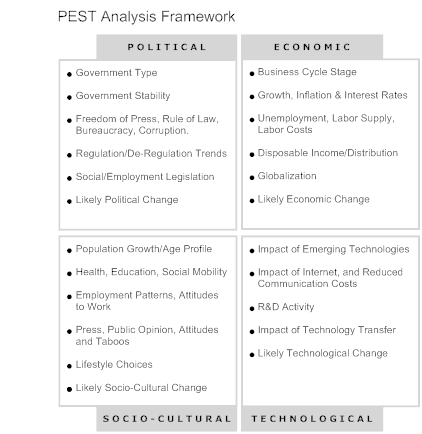
PEST Analysis is a simple, useful and widely-used tool that helps you understand the "big picture" of your Political, Economic, Socio-Cultural and Technological environment. As such, it is used by business leaders worldwide to build their vision of the future.
It is important for these reasons:
First, by making effective use of PEST Analysis, you ensure that what you are doing is aligned positively with the powerful forces of change that are affecting our world. By taking advantage of change, you are much more likely to be successful than if your activities oppose it.
Second, good use of PEST Analysis helps you avoid taking action that is doomed to failure from the outset, for reasons beyond your control.
Third, PEST is useful when you start operating in a new country or region. Use of PEST helps you break free of unconscious assumptions, and helps you quickly adapt to the realities of the new environment.
Political:
- Government type and stability.
- Freedom of press, rule of law and levels of bureaucracy and corruption.
- Regulation and de-regulation trends.
- Social and employment legislation.
- Tax policy, and trade and tariff controls.
- Environmental and consumer-protection legislation.
- Likely changes in the political environment.
Economic:
- Stage of business cycle.
- Current and project economic growth, inflation and interest rates.
- Unemployment and labor supply.
- Labor costs.
- Levels of disposable income and income distribution.
- Impact of globalization.
- Likely impact of technological or other change on the economy.
- Likely changes in the economic environment.
Socio-Cultural:
- Population growth rate and age profile.
- Population health, education and social mobility, and attitudes to these.
- Population employment patterns, job market freedom and attitudes to work.
- Press attitudes, public opinion, social attitudes and social taboos.
- Lifestyle choices and attitudes to these.
- Socio-cultural changes.
- Technological Environment:
Impact of emerging technologies.
- Impact of Internet, reduction in communications costs and increased remote working.
- Research and development activity.
- Impact of technology transfer.
Other forms of PEST - PESTLE, PESTLIED, STEEPLE and SLEPT:
Some people prefer to use different flavors of PEST Analysis, using other factors for different situations. The variants are:
PESTLE/PESTEL: Political, Economic, Sociological, Technological, Legal, Environmental.
PESTLIED: Political, Economic, Social, Technological, Legal, International, Environmental, Demographic.
STEEPLE: Social/Demographic, Technological, Economic, Environmental, Political, Legal, Ethical.
SLEPT: Social, Legal, Economic, Political, Technological.
Source: http://www.mindtools.com/pages/article/newTMC_09.htm
The Five Competitive Forces - by Michael E. Porter
Bargaining Power of Suppliers
The term 'suppliers' comprises all sources for inputs that are needed in order to provide goods or services.
Supplier bargaining power is likely to be high when:
•The market is dominated by a few large suppliers rather than a fragmented source of supply,
•There are no substitutes for the particular input,
•The suppliers customers are fragmented, so their bargaining power is low,
•The switching costs from one supplier to another are high,
•There is the possibility of the supplier integrating forwards in order to obtain higher prices and margins. This threat is especially high when
•The buying industry has a higher profitability than the supplying industry,
•Forward integration provides economies of scale for the supplier,
•The buying industry hinders the supplying industry in their development (e.g. reluctance to accept new releases of products),
•The buying industry has low barriers to entry.
In such situations, the buying industry often faces a high pressure on margins from their suppliers. The relationship to powerful suppliers can potentially reduce strategic options for the organization.
Bargaining Power of Customers
Similarly, the bargaining power of customers determines how much customers can impose pressure on margins and volumes.
Customers bargaining power is likely to be high when
•They buy large volumes, there is a concentration of buyers,
•The supplying industry comprises a large number of small operators
•The supplying industry operates with high fixed costs,
•The product is undifferentiated and can be replaces by substitutes,
•Switching to an alternative product is relatively simple and is not related to high costs,
•Customers have low margins and are price-sensitive,
•Customers could produce the product themselves,
•The product is not of strategical importance for the customer,
•The customer knows about the production costs of the product
•There is the possibility for the customer integrating backwards.
Threat of New Entrants
The competition in an industry will be the higher, the easier it is for other companies to enter this industry. In such a situation, new entrants could change major determinants of the market environment (e.g. market shares, prices, customer loyalty) at any time. There is always a latent pressure for reaction and adjustment for existing players in this industry.
The threat of new entries will depend on the extent to which there are barriers to entry. These are typically:-
•Economies of scale (minimum size requirements for profitable operations),
•High initial investments and fixed costs,
•Cost advantages of existing players due to experience curve effects of operation with fully depreciated assets,
•Brand loyalty of customers
•Protected intellectual property like patents, licenses etc,
•Scarcity of important resources, e.g. qualified expert staff
•Access to raw materials is controlled by existing players,
•Distribution channels are controlled by existing players,
•Existing players have close customer relations, e.g. from long-term service contracts,
•High switching costs for customers
•Legislation and government action
Threat of Substitutes
A threat from substitutes exists if there are alternative products with lower prices of better performance parameters for the same purpose. They could potentially attract a significant proportion of market volume and hence reduce the potential sales volume for existing players. This category also relates to complementary products.
Similarly to the threat of new entrants, the treat of substitutes is determined by factors like:-
•Brand loyalty of customers,
•Close customer relationships,
•Switching costs for customers,
•The relative price for performance of substitutes,
•Current trends.
Competitive Rivalry between Existing Players
This force describes the intensity of competition between existing players (companies) in an industry. High competitive pressure results in pressure on prices, margins, and hence, on profitability for every single company in the industry.
Competition between existing players is likely to be high when:-
•There are many players of about the same size,
•Players have similar strategies
•There is not much differentiation between players and their products, hence, there is much price competition
•Low market growth rates (growth of a particular company is possible only at the expense of a competitor),
•Barriers for exit are high (e.g. expensive and highly specialized equipment).
Influencing the Power of Five Forces
After the analysis of current and potential future state of the five competitive forces, managers can search for options to influence these forces in their organization’s interest. Although industry-specific business models will limit options, the own strategy can change the impact of competitive forces on the organization. The objective is to reduce the power of competitive forces.
The following summary provides some solutions. They are of general nature. Hence, they have to be adjusted to each organization’s specific situation. The options of an organization are determined not only by the external market environment, but also by its own internal resources, competences and objectives.
Reducing the Bargaining Power of Suppliers
- Partnering
- Supply chain management
- Supply chain training
- Increase dependency
- Build knowledge of supplier costs and methods
- Take over a supplier
Reducing the Bargaining Power of Customers
- Partnering
- Supply chain management
- Increase loyalty
- Increase incentives and value added
- Move purchase decision away from price
- Cut put powerful intermediaries (go directly to customer)
Reducing the Treat of New Entrants
- Increase minimum efficient scales of operations
- Create a marketing / brand image (loyalty as a barrier)
- Patents, protection of intellectual property
- Alliances with linked products / services
- Tie up with suppliers
- Tie up with distributors
- Retaliation tactics
Reducing the Threat of Substitutes
- Legal actions
- Increase switching costs
- Alliances
- Customer surveys to learn about their preferences
- Enter substitute market and influence from within
- Accentuate differences (real or perceived)
Reducing the Competitive Rivalry between Existing Players
- Avoid price competition
- Differentiate your product
- Buy out competition
- Reduce industry over-capacity
- Focus on different segments
- Communicate with competitors
Source: http://www.mindtools.com/pages/article/newTMC_08.htm
Thursday, April 1, 2010
How to Implement TQM?
Many Quality efforts are missing a key ingredient: a set of meaningful measurements. The leaders of modern organizations typically believe that they have too many measurements. The fact is, people need training on how to choose and use this tool effectively. Here's a key opportunity to accelerate your quality activities and the results they produce.
What To Measure
Companies tend to measure certain areas:
• money- sales, costs, profits, assets
• activity - number of policies issued, units sold,
• sales calls made, etc.
• schedules - completion, delinquencies, deadlines
• "pain" - customer complaints, accidents, resignations, penalties
Managers are evaluated and rewarded according to "their numbers" in these areas, cutting costs, getting work out, meeting schedules, and avoiding pain. Quality is not really included as an integral part of departmental routines or managerial performance appraisals.
Properly selected measurements produce dramatic improvements in quality and profitability. Adequately-trained managers can use these measurements to tackle their assignments from a different perspective: focusing on the processes for accomplishing work, rather than "pointing fingers" at their co-workers. As an example, work groups could be measuring:
• Avoidable instances of overtime, express shipments or expediting
• Accuracy and completeness of outcomes or supplier inputs
• Delays, missing information, material shortages, changes in schedule
• Returned goods, lost time accidents or instances of employee dissatisfaction
The resulting information would demonstrate "Where, When and Why" quality isn't happening. This type of discovery leads to improvement. The company learns to operate better, faster and cheaper. Employees enjoy more satisfaction and less stress.
Use Of Measurements
Most of us have been raised in the traditional management system, shaping our expectations of what is measured and how the information should be used. Imagine a group of co-workers arriving at your office: "We're from the Measurement Committee and we're here to help you." How warmly would they be received? Like Internal Revenue Service auditors, most likely. Measurements have often been misapplied, in an effort to motivate people or place blame for problems.
Measurement should be used as a helpful tool, not a weapon. It can increase understanding of how processes are operating, and why operations are failing to produce expected results. Correct application of measurement helps answer the question "Where did the process break down?" Others to look at includes:
1. How many delays were encountered in entering or filling customer orders?
2. How often was the warehouse out of stock?
3. How much equipment downtime occurred on second shift?
4. What were the costs (and causes) of engineering changes?
These kinds of answers help employees learn about work processes, and lead to discovery of why problems occur.
The 10 Prerequisites For Successful Measurement
There are 10 preexisting conditions for successful measurement. The measurements are successful because the prerequisites for success have been provided. Has your operation developed the support necessary for successful measurement? It does if:
1. The areas being measured are important to the customers, employees or suppliers involved; i.e. timeliness, accuracy, completeness or cost.
2. Each measurement is part of a defined and documented process; i.e. clearly established methods, procedures, equipment, training.
3. The process is operated according to clear requirements; established for outcome, supplier inputs and sequence of operations.
4. The area being measured is important to managers or supervisors who control work group time and resources; i.e. improved performance pays personal benefits.
5. The employees involved believe they can do something to streamline or improve the process; knowledge and authority to make changes.
6. The measurement tools used are appropriate for the task at hand, i.e. not too simple or complex.
7. Measurement results are periodically reviewed; i.e. daily, weekly, monthly.
8. People use the measurements to stimulate thought, discussion and actions.
9. Employees trust that actions will be focused on the process, not the people involved; "How can we improve the process" versus "Who screwed up?"
10. Everyone is recognized for their efforts and rewarded for progress; a small celebration, pat on the back, or better bonus at the end of the year.
What To Measure
Companies tend to measure certain areas:
• money- sales, costs, profits, assets
• activity - number of policies issued, units sold,
• sales calls made, etc.
• schedules - completion, delinquencies, deadlines
• "pain" - customer complaints, accidents, resignations, penalties
Managers are evaluated and rewarded according to "their numbers" in these areas, cutting costs, getting work out, meeting schedules, and avoiding pain. Quality is not really included as an integral part of departmental routines or managerial performance appraisals.
Properly selected measurements produce dramatic improvements in quality and profitability. Adequately-trained managers can use these measurements to tackle their assignments from a different perspective: focusing on the processes for accomplishing work, rather than "pointing fingers" at their co-workers. As an example, work groups could be measuring:
• Avoidable instances of overtime, express shipments or expediting
• Accuracy and completeness of outcomes or supplier inputs
• Delays, missing information, material shortages, changes in schedule
• Returned goods, lost time accidents or instances of employee dissatisfaction
The resulting information would demonstrate "Where, When and Why" quality isn't happening. This type of discovery leads to improvement. The company learns to operate better, faster and cheaper. Employees enjoy more satisfaction and less stress.
Use Of Measurements
Most of us have been raised in the traditional management system, shaping our expectations of what is measured and how the information should be used. Imagine a group of co-workers arriving at your office: "We're from the Measurement Committee and we're here to help you." How warmly would they be received? Like Internal Revenue Service auditors, most likely. Measurements have often been misapplied, in an effort to motivate people or place blame for problems.
Measurement should be used as a helpful tool, not a weapon. It can increase understanding of how processes are operating, and why operations are failing to produce expected results. Correct application of measurement helps answer the question "Where did the process break down?" Others to look at includes:
1. How many delays were encountered in entering or filling customer orders?
2. How often was the warehouse out of stock?
3. How much equipment downtime occurred on second shift?
4. What were the costs (and causes) of engineering changes?
These kinds of answers help employees learn about work processes, and lead to discovery of why problems occur.
The 10 Prerequisites For Successful Measurement
There are 10 preexisting conditions for successful measurement. The measurements are successful because the prerequisites for success have been provided. Has your operation developed the support necessary for successful measurement? It does if:
1. The areas being measured are important to the customers, employees or suppliers involved; i.e. timeliness, accuracy, completeness or cost.
2. Each measurement is part of a defined and documented process; i.e. clearly established methods, procedures, equipment, training.
3. The process is operated according to clear requirements; established for outcome, supplier inputs and sequence of operations.
4. The area being measured is important to managers or supervisors who control work group time and resources; i.e. improved performance pays personal benefits.
5. The employees involved believe they can do something to streamline or improve the process; knowledge and authority to make changes.
6. The measurement tools used are appropriate for the task at hand, i.e. not too simple or complex.
7. Measurement results are periodically reviewed; i.e. daily, weekly, monthly.
8. People use the measurements to stimulate thought, discussion and actions.
9. Employees trust that actions will be focused on the process, not the people involved; "How can we improve the process" versus "Who screwed up?"
10. Everyone is recognized for their efforts and rewarded for progress; a small celebration, pat on the back, or better bonus at the end of the year.
Subscribe to:
Posts (Atom)